Hong Kong Alzheimer Drugs Market Analysis Industry Trends and Forecast to 2034: Segmented by (By Drug Class, By Route of Administration, By Distribution Channel, By Region) - Growth, Market Size, Future Prospects & Competitive Analysis, 2024-2034
Overview
Market Dashboard
Hong Kong · 2024–2034 · placeholder estimates
Values shown here are placeholder estimates, not researched figures. Researched 2024 historical, 2025 base-year and 2026–2034 forecast values are prepared with the
full report.
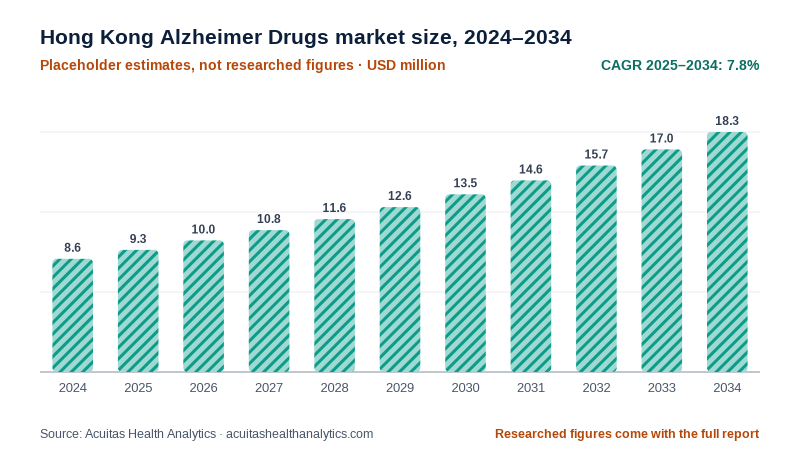
Estimate 2024$8.6 MnPlaceholder estimate
Estimate 2025$9.3 MnPlaceholder estimate
Projected 2034$18.3 Mn 96.6%Adds $9.0 Mn over 9 forecast years
CAGR 2025–20347.8%Faster than 33% of 186 Pharmaceuticals markets here
9 in Hong KongSource: ClinicalTrials.gov, Studies recruiting, active or not yet recruiting, in Hong Kong. Retrieved 9 Nov 2026.
Formats
PDF, PPTX, XLSX
Sizes and growth here are placeholder estimates, not researched figures. Researched figures come with the full report.
The Hong Kong Alzheimer Drug Market Analysis Executive Summary
Alzheimer’s disease is a chronic neurodegenerative illness that is noticeable by the formation of the senile plaques and neurofibrillary tangles which leads to reduced size of the brain. It is the most prevalent type of dementia, a progressive worsening of memory, thinking, behaviour, and the ability to perform daily tasks. The initial symptoms are somewhat subtle and include having no memory of recent events; in advanced stages, the patient develops severe dementia which affects basic bodily functions. Unfortunately, there are medications available to manage the frequency of symptoms, but there is no cure for the condition. In later stages, serious complications such as dehydration, malnutrition, or infections may arise, any of which can be life-threatening. Counselling and other support services may be provided based on the needs of the patient and their caregivers.
Every 3 seconds, someone develops dementia. In 2020, over 55 million people worldwide had dementia, a number expected to nearly double by 2030. Most cases are in developing countries, with 60% in low and middle-income regions, projected to rise to 71% by 2050, particularly in China, India, and nearby regions. Common Alzheimer's medications include Donepezil, Rivastigmine, Galantamine, and Memantine. Newer FDA-approved drugs like Lecanemab and Donanemab target beta-amyloid proteins for early treatment. Recent M&A activities indicate a trend towards market consolidation, with companies like Merck expanding partnerships, such as with Cerevance, to diversify their portfolios. This comes as countries enhance dementia strategies and improve Alzheimer's diagnosis and treatment. As the market advances, businesses are focusing on joint ventures and product development, though challenges like regulations and reimbursement remain key hurdles.
Hong Kong Alzheimer Drugs market size, 2024–2034. Placeholder estimates; researched figures come with the full report. Source: Acuitas Health Analytics.
Hong Kong Alzheimer Drug Market Dynamics
Market Growth Drivers
Currently, over 55 million people worldwide are living with dementia, with more than 60% residing in low- and middle-income countries. Each year, nearly 10 million new cases are reported. Since Alzheimer's primarily affects older individuals, this increase can largely be attributed to the aging population. The diagnosis and treatment of Alzheimer's disease are receiving significant funding for research and development. For example, funding for the NIH increased to $3.348 billion in 2022 from $3.059 billion in 2021. Alzheimer's can now be diagnosed earlier and with greater accuracy because to the growing use of biomarkers in diagnosis and medication research. It is anticipated that this pattern will encourage the development of novel treatments.
Opportunity
Research on Alzheimer's disease biomarkers holds significant promise for enhancing early diagnosis, disease staging, and monitoring treatment responses. Biomarkers can facilitate rapid diagnosis, enabling early treatment and paving the way for disease-modifying therapies (DMTs) that target the underlying causes of Alzheimer's. Ongoing investment in DMTs is essential for addressing patient and healthcare system needs. Furthermore, digital health technologies, such as remote monitoring and cognitive assessment apps, present the potential to improve patient care by delivering real-time data for personalized treatment strategies.
Market Restraints
The regulatory landscape, characterized by rigorous approval processes and protracted trials, can also discourage investment. Controversies surrounding the approval of Aduhelm raise concerns about drug efficacy, impacting market confidence. The high costs associated with new disease-modifying treatments (DMTs), such as Leqembi and Aduhelm, further limit patient access and burden healthcare systems. The underdiagnosis and misdiagnosis of Alzheimer's worsen these challenges, highlighting the necessity for effective diagnostic tools. Alzheimer's manifests differently in individuals, complicating the development of standardized treatments. Researchers must ensure that trial participants are adequately comparable to yield valid results, complicating the design of clinical trials and the development of medications.
Competitive Landscape for Alzheimer Drug Market in Hong Kong
July 2024, FDA approves new Alzheimer's treatment, Kisunla (donanemab) from Eli Lilly.
July 2025, Lecanemab was fully approved by the FDA as a treatment for early Alzheimer’s disease. This means that it can now be given to patients with early Alzheimer’s disease in the USA. The drug is being marketed under the name Leqembi.
Mergers and Acquisitions
August 2024, Linus Health, a digital health company enabling early detection of cognitive impairment, Alzheimer’s, and other dementias, today announced its acquisition of Together Senior Health (Together), a brain health company delivering evidence-based solutions for individuals with cognitive decline, Alzheimer’s disease, and related dementias. Together will be a wholly-owned subsidiary of Linus Health.
August 2022, Merck & Co. has struck a deal with Boston-based Cerevance to acquire one of its research programs and work together on discovering new protein targets in the brain. Under the agreement, Cerevance will receive an initial payment of $25 million, with the potential to earn up to an additional $1.1 billion if specific development and commercial milestones are achieved.
Healthcare Policies and Regulatory Landscape for Alzheimer Drug Market in Hong Kong
Alzheimer Drugs in Hong Kong: rules, payment and research
Pharmaceutical products must be registered with the Pharmacy and Poisons Board before sale, through the Drug Office of the Department of Health.[1] Public hospitals and clinics, run by the Hospital Authority, are heavily subsidised by the government.[2] ClinicalTrials.gov lists 9 studies on Alzheimer Drugs that are recruiting, active or about to start in Hong Kong.[3]
[3]ClinicalTrials.gov, Studies recruiting, active or not yet recruiting, in Hong Kong. Retrieved 9 Nov 2026.
Policy changes and Reimbursement scenario
The regulatory landscape for Alzheimer's drugs is evolving, especially in the U.S. and Europe. In 2022, CMS introduced a policy for covering FDA-accelerated drugs like Aducanumab, with coverage under specific conditions, sparking debate over treatment costs and access. European countries like Germany and France are also closely evaluating the clinical benefits of new Alzheimer's drugs before approving reimbursement. In March 2024, the FDA issued revised guidance encouraging the use of surrogate endpoints in early-stage Alzheimer's drug development. Early consultation with the FDA is advised to ensure these endpoints meet regulatory standards. Overall, there is a shift towards evidence-based regulation, requiring clear proof of clinical benefit for broader adoption and reimbursement of Alzheimer's therapies.
7.6 F. Hoffmann-La Roche AG Product & Services, Strategies & Financials
7.7 Eli Lilly and Company Product & Services, Strategies & Financials
8 Healthcare Policies and Regulatory Landscape
8.1 Policy changes and Reimbursement scenario
8.2 Government Initiatives / Intervention programs
Alzheimer's disease drugs market can be divided based on drug class, route of administration, distribution channel, region, and disease severity to provide a comprehensive analysis of the competitive landscape and growth opportunities.
Other companies that free public records show in this market: trials they lead, US approvals and WHO prequalification. They are not part of our key players research. Each count opens its source.
Also active in this area, from free public records
Source: ClinicalTrials.gov, Active studies (recruiting, about to start or running) each company leads, found with this market's trial search, worldwide. Retrieved 13 Nov 2026.
Beyond the market numbers
Research, trials and patients
What doctors and scientists are doing in Alzheimer Drugs right now, from free public sources.
Sources:PubMed (US National Library of Medicine),
ClinicalTrials.gov,
World Bank.
Fetched 9 Nov 2026. Papers and trials are found by search words, so the counts are a guide. Titles only; read each paper at its source.
Public data, with sources
Alzheimer Drugs in context
Hong Kong compared
People aged 65 and over: 23.7% of people (2025). World: 10.4% of people (2025). 2nd highest of the 18 countries we cover in APAC.[1]
[1]World Bank Open Data, People aged 65 and over (% of people). Retrieved 23 Nov 2026.
How big is the Alzheimer Drugs market in Hong Kong?
Placeholder estimate: about $9.3 Mn in 2025, rising to about $18.3 Mn by 2034. These are early estimates, not researched figures; the researched values come with the full report.
How fast is the Alzheimer Drugs market in Hong Kong growing?
Placeholder estimate: about 7.8% a year (CAGR, 2025–2034). The researched growth rate comes with the full report.
What segments does the Alzheimer Drugs market report cover?
The report splits the market by drug class (AChE Inhibitors (e.g. donepezil, rivastigmine, galantamine), NMDA-R antagonists (e.g. memantine), Other neurotransmitter modulators), route of administration (Oral, Transdermal, Injectable) and distribution channel (Hospital Pharmacies, Retail Pharmacies, Online Pharmacies).
Who are the key players in the Alzheimer Drugs market?
Key players include AbbVie Inc., Novartis AG, Biogen Inc, Lundbeck, Otsuka Pharmaceutical Co., Ltd. and Roche, among 7 companies the report profiles.
What is driving the Alzheimer Drugs market?
Currently, over 55 million people worldwide are living with dementia, with more than 60% residing in low- and middle-income countries. Each year, nearly 10 million new cases are reported. Since Alzheimer's primarily affects older individuals, this increase can largely be attributed to the aging population.
Who regulates Alzheimer Drugs in Hong Kong?
Pharmaceutical products must be registered with the Pharmacy and Poisons Board before sale, through the Drug Office of the Department of Health. Source: Drug Office, Department of Health. Checked 14 Nov 2026.
How is healthcare paid for in Hong Kong?
Public hospitals and clinics, run by the Hospital Authority, are heavily subsidised by the government. Source: Hospital Authority. Checked 14 Nov 2026.
How many clinical trials on Alzheimer Drugs are running in Hong Kong?
9 studies are recruiting, active or about to start in Hong Kong, according to ClinicalTrials.gov. Source: ClinicalTrials.gov, Studies recruiting, active or not yet recruiting, in Hong Kong. Retrieved 9 Nov 2026.
How much research is published on Alzheimer Drugs?
PubMed lists 30,470 papers on Alzheimer Drugs added since January 2021, worldwide. Source: PubMed, Papers added since 1 January 2021 matching this market. Retrieved 9 Nov 2026.
 Hong Kong



 China
 India
 Kenya
 US
 Canada
 Japan
 Germany
 France
 UK
 Brazil
 Italy
 Ecuador
 Spain
 Saudi Arabia
 Mexico
 Australia
 South Africa
 UAE
 Egypt
 Philippines
 Malaysia
 Singapore
 Thailand
 Bristol-Myers Squibb
 GSK PLC