Hong Kong Cannabidiol (CBD) Market Analysis Industry Trends and Forecast to 2034: Segmented by (By Source, By Product Type, By Route of Administration, By Distribution Channel, By End Use, By Region) - Growth, Market Size, Future Prospects & Competitive Analysis, 2024-2034
Overview
Market Dashboard
Hong Kong · 2024–2034 · placeholder estimates
Values shown here are placeholder estimates, not researched figures. Researched 2024 historical, 2025 base-year and 2026–2034 forecast values are prepared with the
full report.
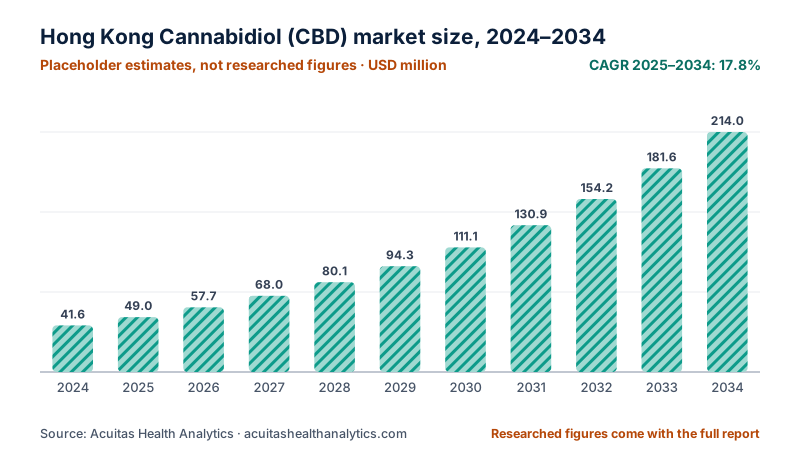
Estimate 2024$41.6 MnPlaceholder estimate
Estimate 2025$49.0 Mn0.2% of the global market
Projected 2034$214.0 Mn 336.8%Adds $165.0 Mn over 9 forecast years
CAGR 2025–203417.8%Faster than 81% of 180 Pharmaceuticals markets here
Sizes and growth here are placeholder estimates, not researched figures. Researched figures come with the full report.
The Hong Kong Cannabidiol (CBD) Market Analysis Executive Summary
CBD or cannabidiol is the second most abundant cannabinoid present in the cannabis plant and does not have psychoactive effects on the human body. It is extracted from the cannabis sativa plant or synthesized in a chemist and forms a raw material of medical marijuana. According to the World Health Organization, CBD is not associated with abuse or dependence potential and there are no signs of public health problems with the use of the substance. According to a research in Neuropsychopharmacology, the effects of CBD are not likely to hinder one’s functionality in the day or in the workplace.
About 147 million people, 2.5% of the world population, consume cannabis (annual prevalence) compared with 0.2% consuming cocaine and 0.2% consuming opiates. One of the most recognizable forms of cannabidiol (CBD) is Epidiolex, which is prescribed for specific types of seizures, including Lennox-Gastaut syndrome and Dravet syndrome and for managing seizures resulting from tuberous sclerosis. It is used as a secondary medication for these illnesses. CBD market is emerging as the awareness among people about cannabis continues to rise, legalization of cannabis and the increased demand for its health benefits. The market is dominated by North America, especially the United States, with Europe as another substantial market. Nonetheless, the use of CBD is legal differently across the globe, and this comes with challenges that may slow the growth of the industry. CBD is being sought after as a pain reliever, anxiolytic and sleep aid, thus the increasing sales of CBD wellness products. The market is relatively diverse, major participants such as Charlotte’s Web and Canopy Growth Corporation diversify their product offerings and markets. Shifts in delivery technologies and higher levels of M&A activity are driving the market. Despite the bright future, threats like regulatory concerns, supply chain disruptions, and competition with synthetic cannabinoids exist.
Hong Kong Cannabidiol (CBD) market size, 2024–2034. Placeholder estimates; researched figures come with the full report. Source: Acuitas Health Analytics.
Hong Kong Cannabidiol (CBD) Market Dynamics
Market Growth Drivers
The general population is also gradually discovering that CBD is good for their health in areas like inflammation, anxiety, and pain relieve which makes its application range from the food and beverage industry up to the cosmetics and pharmaceutical industries. Legalization of hemp and marijuana is creating more CBD markets and better rules promotes more investment in products and its marketing. Technological advancement is translating into the development of polymorphic CBD products such as the oils, edibles and lotions among others. Attributing to increased consumer propensity towards natural and organic products as well as non-conventional medicines. New studies and experiments should enhance the understanding of the medicinal potential of CBD, and thus, popularize its application. There is also increase in access which is improving demand as different businesses expand their markets and meet the shifting demand.
Opportunity
Currently the CBD market is growing rapidly since countries across the world are legalizing cannabis and CBD products for medical as well as for recreational purposes. This growth is due to the rising consumer preference for Cannabidiol attributing to its health benefits such as alleviation of anxiety, treating seizures, and easing of pain. It is also supported by the increasing application of CBD into foods, medicines and personal care products. CBD oil is among the latest product types that the manufacturers are aiming to tap into with new products. Further, they are pointing to the enhancement of merger and acquisition activity as a source of the market expansion. The Asia Pacific region with developing markets such as China, Japan, and India particularly contributed to this growth because consumers of all ages and across all demographics have an increasing demand for natural and holistic medicine.
Market Restraints
Regulations regarding consumption of CBD are thus transitional and different in every country creating legal uncertainty and challenges for companies and industries to operate. This is mainly because inconsistent testing and quality control measures may lead to consumer skepticism, more so for products that are matters of potency and safety. Part of the risk associated with CBD use is the potential for companies promoting false claims and health benefits about their products and causing reputational and legal repercussions. Nonetheless, it is crucial to note that despite CBD being safe and legal, it should be taken more research is still needed in order to determine the impacts of CBD in the long-run, not forgetting the fact that it also interacts with other chemicals in the body. Concentrated CBD products that are not regulated are highly likely to compete with legal products as they seek to corner the market share among price-sensitive consumers. Further, because of the intricate interconnectivity of the global supply system, the supply of products and prices of manufactured products can be distorted - thus destabilizing the market.
Competitive Landscape for Cannabidiol (CBD) Market in Hong Kong
January 2022, CV Sciences introduced four new +PlusCBD Oil products to enhance its product lineup.
January 2022, Elixinol has launched two novel CBD products targeting sleep support: the Sleep Rapid Rest Liposome and Sleep Gummies. The Sleep Rapid Rest Liposome incorporates a proprietary formulation combining cannabinol (CBN), cannabidiol (CBD), chamomile extract, and lemon balm extract. The Sleep Gummies contain 2 mg of CBN and 15 mg of CBD per dose.
Mergers and Acquisitions
February 2024, British Cannabis has acquired Goodbody Botanicals Ltd, a rising company in herbal wellness and cosmetics. This acquisition is designed to expand British Cannabis’s product range and global reach, underscoring the current trend of consolidation in the CBD sector as companies aim to diversify their portfolios and solidify their market positions.
October 2021, CanaFarma Hemp, headquartered in New Jersey, has signed a letter of intent to acquire Avitas Bio. This acquisition is part of a broader strategy that also involves a $50 million merger with Vertical Wellness. The goal is to establish a unified portfolio of CBD brands that will be publicly traded, reflecting a notable move towards larger, integrated operations in the industry.
October 2021, CBD Global Sciences, based in Colorado, has announced its agreement to acquire 100% of Resinosa, which runs a GMP-certified extraction facility. This acquisition is anticipated to enhance CBD Global Sciences' production capacity and broaden its product range, with a focus on the sports nutrition and wellness sectors.
Healthcare Policies and Regulatory Landscape for Cannabidiol (CBD) Market in Hong Kong
Cannabidiol (CBD) in Hong Kong: rules and payment
Pharmaceutical products must be registered with the Pharmacy and Poisons Board before sale, through the Drug Office of the Department of Health.[1] Public hospitals and clinics, run by the Hospital Authority, are heavily subsidised by the government.[2]
New 2021 CBD Trends and Regulations includes: It is imperative to know that numerous states have deemed certain registrations or licenses compulsory for the retailers, manufacturers and distributors of hemp products, even if the enforcement differs. DT means documents like bills of lading are necessary in many states, though some of them require inspection. Others can be in form of restrictions placed by shipping companies. CBD advertising rules are strict in most states where it is sold: labeling must include a QR code and warnings, for instance, if a product contains THC like California warnings. Several states prohibit one or both forms of smokable hemp and products and New York has even considered putting health warnings on them. The states are following strict testing procedures and safety measures, which could be as rigorous as FDA protocols and many of the states are also limiting serving sizes for hemp products. Even some individual states have banned several cannabinoids such as delta 8 and delta 10 THC. This is because CBD has medicinal values, which has seen the incorporation of these products in the health reimbursement system. The following is increasing: Extent of coverage is expected to rise, especially for CBD products cleared by the FDA or backed by clinical evidence, factors which can improve consumers’ access to the market. However, there are concerns, such as a more precise dosing regimen, strict quality control, and detailed documentation of patient records. Underpinning legislation shall also act as critical factors in prevalence as well as the rate of reimbursement enrollment.
Sources:PubMed (US National Library of Medicine),
ClinicalTrials.gov,
World Bank.
Fetched 9 Nov 2026. Papers and trials are found by search words, so the counts are a guide. Titles only; read each paper at its source.
Public data, with sources
Cannabidiol (CBD) in context
Hong Kong compared
People aged 65 and over: 23.7% of people (2025). World: 10.4% of people (2025). 2nd highest of the 16 countries we cover in APAC.[1]
[1]World Bank Open Data, People aged 65 and over (% of people). Retrieved 16 Nov 2026.
How big is the Cannabidiol (CBD) market in Hong Kong?
Placeholder estimate: about $49.0 Mn in 2025, rising to about $214.0 Mn by 2034. These are early estimates, not researched figures; the researched values come with the full report.
How fast is the Cannabidiol (CBD) market in Hong Kong growing?
Placeholder estimate: about 17.8% a year (CAGR, 2025–2034). The researched growth rate comes with the full report.
What segments does the Cannabidiol (CBD) market report cover?
The report splits the market by source (Hemp, Marijuana), product type (Oils, Suppositories, Transdermal patches, Tablets and Capsules and more), route of administration (Oral, Topical, Inhalation, Transdermal and more) and distribution channel (Online, Offline).
Who are the key players in the Cannabidiol (CBD) market?
Key players include Aurora Cannabis, Medical Marijuana Inc, Elixinol, Nuleaf Naturals LLC, Canopy Growth Corporation and CV Sciences, Inc..
What is driving the Cannabidiol (CBD) market?
The general population is also gradually discovering that CBD is good for their health in areas like inflammation, anxiety, and pain relieve which makes its application range from the food and beverage industry up to the cosmetics and pharmaceutical industries.
Who regulates Cannabidiol (CBD) in Hong Kong?
Pharmaceutical products must be registered with the Pharmacy and Poisons Board before sale, through the Drug Office of the Department of Health. Source: Drug Office, Department of Health. Checked 14 Nov 2026.
How is healthcare paid for in Hong Kong?
Public hospitals and clinics, run by the Hospital Authority, are heavily subsidised by the government. Source: Hospital Authority. Checked 14 Nov 2026.
 Hong Kong



 China
 India
 US
 Canada
 Japan
 Germany
 France
 UK
 Brazil
 Italy
 Ecuador
 Spain
 Saudi Arabia
 Mexico
 Australia
 South Africa
 UAE
 Egypt
 Philippines
 Malaysia
 Singapore
 Thailand
 Kenya