Hong Kong Cannabidiol (CBD) Supplements Market Industry Trends and Forecast to 2034: Segmented by (Type, Application, Region) - Growth, Market Size, Future Prospects & Competitive Analysis, 2024-2034
Overview
Market Dashboard
Hong Kong · 2024–2034 · placeholder estimates
Values shown here are placeholder estimates, not researched figures. Researched 2024 historical, 2025 base-year and 2026–2034 forecast values are prepared with the
full report.
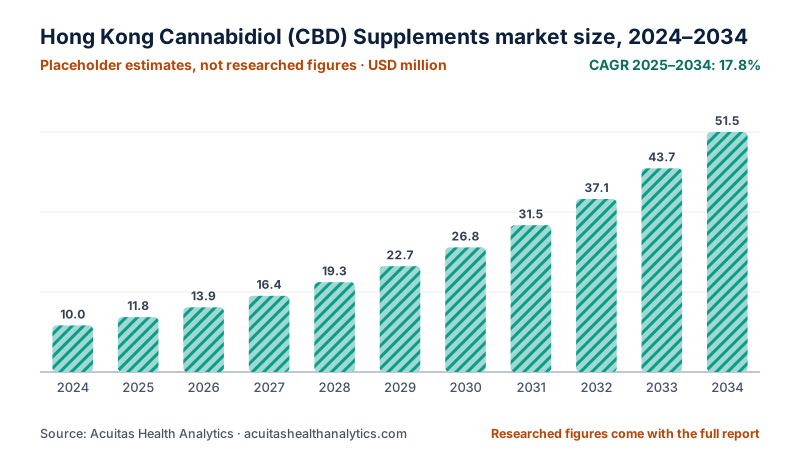
Estimate 2024$10.0 MnPlaceholder estimate
Estimate 2025$11.8 Mn0.2% of the global market
Projected 2034$51.5 Mn 336.8%Adds $39.7 Mn over 9 forecast years
CAGR 2025–203417.8%Faster than 99% of 82 OTC & Nutraceuticals markets here
3 in Hong KongSource: ClinicalTrials.gov, Studies recruiting, active or not yet recruiting, in Hong Kong. Retrieved 9 Nov 2026.
Formats
PDF, PPTX, XLSX
Sizes and growth here are placeholder estimates, not researched figures. Researched figures come with the full report.
The Hong Kong Cannabidiol (CBD) Supplements Market Analysis Executive Summary
Cannabidiol (CBD) supplements are derived from the cannabis plant and contain one of the many active compounds known as cannabinoids. Unlike tetrahydrocannabinol (THC), CBD does not produce psychoactive effects, making it appealing for those seeking therapeutic benefits without the "high." CBD is commonly marketed for its potential health benefits, including relief from anxiety, chronic pain, and inflammation, as well as its use in treating epilepsy through products like Epidiolex, which is FDA-approved for specific seizure disorders.
Globally, the scenario for CBD supplements is rapidly evolving, with increasing consumer interest and acceptance. Research indicates that the use of CBD has surged, particularly in regions where cannabis laws have relaxed. For instance, a survey found that approximately 14% of U.S. adults reported using CBD products in 2019, reflecting a growing trend towards natural remedies. The World Health Organization has noted that CBD exhibits no effects indicative of abuse or dependence potential. However, while the demand for CBD supplements is increasing, concerns remain regarding product quality and regulation. Studies have shown significant variability in CBD content among products sold online, with some containing less CBD than advertised or even THC. This highlights the importance of consumer education and regulatory oversight to ensure safety and efficacy in this burgeoning market.
Hong Kong Cannabidiol (CBD) Supplements market size, 2024–2034. Placeholder estimates; researched figures come with the full report. Source: Acuitas Health Analytics.
Hong Kong Cannabidiol (CBD) Supplements Market Dynamics
Market Growth Drivers
A major driver of this marker is the recent surge of the decriminalisation of CBD and its derivatives in many countries. For example, Canada, South Africa and Thailand are among the countries that have legalized the recreational use of Cannabis and its derivatives. Additionally there have been several scientific papers that have been published that have advocated for the use of CBD products in the treatment of chronic illnesses. A survey found that about 68% of users reported effectiveness in alleviating symptoms such as anxiety and pain. The rise of e-commerce platforms has also made CBD supplements more accessible to consumers, allowing for greater variety and convenience in purchasing. As awareness of the potential benefits continues to spread, more individuals are willing to incorporate CBD supplements into their health regimens
Opportunity
With the increased funding in the research of the benefits of CBD supplements, there is an opportunity for companies to diversify and create novel products that can reach a wider and more diverse customer base. Gummies and other edible CBD products are quite popular with consumers, hence there is an opportunity to intensify marketing of these products in order to gain a larger market share.
Market Restraints
A major restraint of this market is the negative image that CBD supplements have among consumers. As CBD is derived from the hemp plant (also known as marijuana) CBD products are usually misrepresented as drugs even though they do not contain the psychoactive ingredient that produces a high. Another restraint is that the use of marijuana and its derivatives, including CBD, is still considered a criminal offence in most territories which restricts the growth of this market. One more significant concern is the lack of regulation and quality control in the CBD market, which can lead to inconsistencies in product potency and purity. Research has shown that many CBD products do not contain the levels of cannabinoids advertised on their labels, raising concerns about consumer safety. Additionally, while some studies suggest positive outcomes, comprehensive clinical research on long-term effects and efficacy is still limited, which can lead to skepticism among potential users
Competitive Landscape for Cannabidiol (CBD) Supplements Market in Hong Kong
In January 2022, CV Sciences Inc launched +PlusCBD pain treatment topicals with four OTC medications used to target the origins of minor aches and pains.
In January 2021, Nano Hydrate made their pharmaceutical-grade branding services available.
Mergers and Acquisitions
In June 2021, Green Roads was acquired by The Valens Company for $60 million. The Valens Company now has access to the extensive and well-established networks in the US CBD industry.
Healthcare Policies and Regulatory Landscape for Cannabidiol (CBD) Supplements Market in Hong Kong
Cannabidiol (CBD) Supplements in Hong Kong: rules and research
Pharmaceutical products must be registered with the Pharmacy and Poisons Board before sale, through the Drug Office of the Department of Health.[1] Health supplements are generally regulated as food, overseen by the Centre for Food Safety; proprietary Chinese medicines must be registered with the Chinese Medicine Council.[2] ClinicalTrials.gov lists 3 studies on Cannabidiol (CBD) Supplements that are recruiting, active or about to start in Hong Kong.[3]
[3]ClinicalTrials.gov, Studies recruiting, active or not yet recruiting, in Hong Kong. Retrieved 9 Nov 2026.
Although the benefits of CBD supplements are reported by many companies in this industry, regulatory bodies do not recognize CBD products as dietary supplements. For example the FDA of the United States of America bans CBD claims for the diagnosis, cure, mitigation, treatment or prevention of disease. The FDA also bans adding CBD to human or animal food products, however the addition of CBD in cosmetic products is allowed.
8.2 Government Initiatives / Intervention programs
The Cannabidiol (CBD) Supplements Market is divided into following segments: Type, Application, and Region. As these segments grow, you will be able to analyze the industries' meagre growth areas and give users useful market insights and an overview to aid in their strategic decision-making when it comes to selecting key market applications.
Other companies that free public records show in this market: trials they lead, US approvals and WHO prequalification. They are not part of our key players research. Each count opens its source.
Also active in this area, from free public records
Source: ClinicalTrials.gov, Active studies (recruiting, about to start or running) each company leads, found with this market's trial search, worldwide. Retrieved 13 Nov 2026.
Beyond the market numbers
Research, trials and patients
What doctors and scientists are doing in Cannabidiol (CBD) Supplements right now, from free public sources.
Sources:PubMed (US National Library of Medicine),
ClinicalTrials.gov,
World Bank.
Fetched 9 Nov 2026. Papers and trials are found by search words, so the counts are a guide. Titles only; read each paper at its source.
Public data, with sources
Cannabidiol (CBD) Supplements in context
Hong Kong compared
People aged 65 and over: 23.7% of people (2025). World: 10.4% of people (2025). 2nd highest of the 16 countries we cover in APAC.[1]
[1]World Bank Open Data, People aged 65 and over (% of people). Retrieved 18 Nov 2026.
How big is the Cannabidiol (CBD) Supplements market in Hong Kong?
Placeholder estimate: about $11.8 Mn in 2025, rising to about $51.5 Mn by 2034. These are early estimates, not researched figures; the researched values come with the full report.
How fast is the Cannabidiol (CBD) Supplements market in Hong Kong growing?
Placeholder estimate: about 17.8% a year (CAGR, 2025–2034). The researched growth rate comes with the full report.
What segments does the Cannabidiol (CBD) Supplements market report cover?
The report splits the market by type (Hemp-derived, Marijuana-derived) and application (Food and Beverage, Nutraceuticals, Pharmaceuticals, Personal Care and Cosmetics).
Who are the key players in the Cannabidiol (CBD) Supplements market?
Key players include Aphria Inc, Canopy Growth Corporation CV Sciences, Elixinol Global Limited, Freedom Leaf Inc, Folium Biosciences and Green Roads of Florida, among 9 companies the report profiles.
What is driving the Cannabidiol (CBD) Supplements market?
A major driver of this marker is the recent surge of the decriminalisation of CBD and its derivatives in many countries. For example, Canada, South Africa and Thailand are among the countries that have legalized the recreational use of Cannabis and its derivatives.
Who regulates Cannabidiol (CBD) Supplements in Hong Kong?
Pharmaceutical products must be registered with the Pharmacy and Poisons Board before sale, through the Drug Office of the Department of Health. Health supplements are generally regulated as food, overseen by the Centre for Food Safety; proprietary Chinese medicines must be registered with the Chinese Medicine Council. Source: Drug Office, Department of Health. Checked 14 Nov 2026.Source: Centre for Food Safety. Checked 14 Nov 2026.
How many clinical trials on Cannabidiol (CBD) Supplements are running in Hong Kong?
3 studies are recruiting, active or about to start in Hong Kong, according to ClinicalTrials.gov. Source: ClinicalTrials.gov, Studies recruiting, active or not yet recruiting, in Hong Kong. Retrieved 9 Nov 2026.
How much research is published on Cannabidiol (CBD) Supplements?
PubMed lists 5,449 papers on Cannabidiol (CBD) Supplements added since January 2021, worldwide. Source: PubMed, Papers added since 1 January 2021 matching this market. Retrieved 9 Nov 2026.
 Hong Kong



 China
 India
 US
 Canada
 Japan
 Germany
 France
 UK
 Brazil
 Italy
 Ecuador
 Spain
 Saudi Arabia
 Mexico
 Australia
 South Africa
 UAE
 Egypt
 Philippines
 Malaysia
 Singapore
 Thailand
 Kenya