Malaysia Antibody-Drug Conjugates Market Industry Trends and Forecast to 2034: Segmented by (Target, Indication, End User, Region) - Growth, Market Size, Future Prospects & Competitive Analysis, 2024-2034
Overview
Market Dashboard
Malaysia · 2024–2034 · placeholder estimates
Values shown here are placeholder estimates, not researched figures. Researched 2024 historical, 2025 base-year and 2026–2034 forecast values are prepared with the
full report.
Estimate 2024$21.3 MnPlaceholder estimate
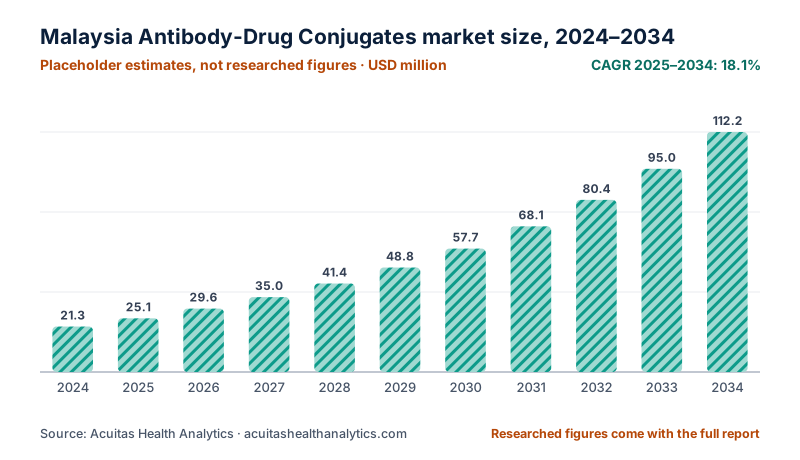
Estimate 2025$25.1 Mn0.2% of the global market
Projected 2034$112.2 Mn 346.9%Adds $87.1 Mn over 9 forecast years
CAGR 2025–203418.1%Faster than 82% of 180 Pharmaceuticals markets here
8 in MalaysiaSource: ClinicalTrials.gov, Studies recruiting, active or not yet recruiting, in Malaysia. Retrieved 12 Nov 2026.
Formats
PDF, PPTX, XLSX
Sizes and growth here are placeholder estimates, not researched figures. Researched figures come with the full report.
The Malaysia Antibody-Drug Conjugates Market Analysis Executive Summary
Antibody-drug conjugates join a cancer-targeting antibody to a strong cancer drug, delivering treatment straight to tumour cells.
Key segments of the antibody-Drug Conjugates market include target (HER2, TROP2 and Nectin-4) and indication (Breast Cancer, Lung Cancer and Bladder Cancer).
Malaysia Antibody-Drug Conjugates market size, 2024–2034. Placeholder estimates; researched figures come with the full report. Source: Acuitas Health Analytics.
Malaysia Antibody-Drug Conjugates Market Dynamics
Market Growth Drivers
Rising cancer cases, earlier detection, precision medicine and a strong pipeline of targeted and immune therapies are driving the antibody-Drug Conjugates market. Faster approvals and new combinations are improving survival.
Opportunity
Biomarker-led treatment, earlier lines of therapy and expansion into emerging markets offer strong growth for the antibody-Drug Conjugates market.
Market Restraints
High treatment costs, drug resistance, side effects and unequal access to cancer centres hold back the antibody-Drug Conjugates market, especially in low- and middle-income countries.
Competitive Landscape for Antibody-Drug Conjugates Market in Malaysia
The antibody-Drug Conjugates market is moderately concentrated. Leading companies compete on product innovation, clinical evidence, pricing and geographic reach, and use partnerships and acquisitions to expand their portfolios.
Healthcare Policies and Regulatory Landscape for Antibody-Drug Conjugates Market in Malaysia
Antibody-Drug Conjugates in Malaysia: rules, payment and research
Medicines must be registered with the Drug Control Authority, which works through the National Pharmaceutical Regulatory Agency (NPRA).[1] Public clinics and hospitals run by the Ministry of Health give heavily subsidised care.[2] ClinicalTrials.gov lists 8 studies on Antibody-Drug Conjugates that are recruiting, active or about to start in Malaysia.[3]
[3]ClinicalTrials.gov, Studies recruiting, active or not yet recruiting, in Malaysia. Retrieved 12 Nov 2026.
Policy changes and Reimbursement scenario
Regulators such as the US FDA, the European Medicines Agency and national drug authorities set approval, pricing and safety rules for antibody-Drug Conjugates. Reimbursement decisions by public payers and insurers shape how fast new therapies reach patients in Malaysia.
2.2 Market Size, Growth Prospects and Key findings
3 Market Dynamics
3.1 Market Growth Drivers Analysis
3.2 Market Restraints Analysis
4 Market Segmentation
4.1 By Target
4.2 By Indication
4.3 By End User
5 By Market Share
5.1 Market Analysis, Insights and Forecast – By Revenue
6 Competitive Landscape
6.1 Major Top Market Players Products in Pipeline
6.2 R&D Initiatives
6.3 Notable recent Deals
6.3.1 Strategic Divestments
6.3.2 Mergers & Acquisitions
6.3.3 Partnerships
6.3.4 Joint Ventures
7 Key Company Profiles
7.1 AstraZeneca
7.2 Daiichi Sankyo
7.3 Pfizer
7.4 Gilead Sciences
7.5 Roche
7.6 AbbVie
8 Healthcare Policies and Regulatory Landscape
8.1 Policy changes and Reimbursement scenario
8.2 Government Initiatives / Intervention programs
The antibody-Drug Conjugates market can be segmented based on various criteria, including target, indication and end user. Here's a breakdown of the market segmentation
Other companies that free public records show in this market: trials they lead, US approvals and WHO prequalification. They are not part of our key players research. Each count opens its source.
Also active in this area, from free public records
Source: ClinicalTrials.gov, Active studies (recruiting, about to start or running) each company leads, found with this market's trial search, worldwide. Retrieved 13 Nov 2026.
Beyond the market numbers
Research, trials and patients
What doctors and scientists are doing in Antibody-Drug Conjugates right now, from free public sources.
Sources:PubMed (US National Library of Medicine),
ClinicalTrials.gov,
World Bank.
Fetched 12 Nov 2026. Papers and trials are found by search words, so the counts are a guide. Titles only; read each paper at its source.
Public data, with sources
Antibody-Drug Conjugates in context
Malaysia compared
Health spending per person: 450 US$ per person (2023). World: 1,317 US$ per person (2023). 7th highest of the 17 countries we cover in APAC.[1]
Doctors: 2.34 per 1,000 people (2023). World: 1.86 per 1,000 people (2022). 7th highest of the 17 countries we cover in APAC.[2]
People aged 65 and over: 8.0% of people (2025). World: 10.4% of people (2025). 10th highest of the 18 countries we cover in APAC.[3]
[1]World Bank Open Data, Health spending per person (US$ per person). Retrieved 19 Nov 2026.
How big is the Antibody-Drug Conjugates market in Malaysia?
Placeholder estimate: about $25.1 Mn in 2025, rising to about $112.2 Mn by 2034. These are early estimates, not researched figures; the researched values come with the full report.
How fast is the Antibody-Drug Conjugates market in Malaysia growing?
Placeholder estimate: about 18.1% a year (CAGR, 2025–2034). The researched growth rate comes with the full report.
What segments does the Antibody-Drug Conjugates market report cover?
The report splits the market by target (HER2, TROP2, Nectin-4, CD30 and more), indication (Breast Cancer, Lung Cancer, Bladder Cancer, Blood Cancers) and end user (Hospitals, Specialty Clinics, Retail Pharmacies, Online Pharmacies).
Who are the key players in the Antibody-Drug Conjugates market?
Key players include AstraZeneca, Daiichi Sankyo Company, Pfizer Inc., Gilead Sciences, Inc., Roche and AbbVie Inc..
What is driving the Antibody-Drug Conjugates market?
Rising cancer cases, earlier detection, precision medicine and a strong pipeline of targeted and immune therapies are driving the antibody-Drug Conjugates market. Faster approvals and new combinations are improving survival.
Who regulates Antibody-Drug Conjugates in Malaysia?
Medicines must be registered with the Drug Control Authority, which works through the National Pharmaceutical Regulatory Agency (NPRA). Source: National Pharmaceutical Regulatory Agency. Checked 14 Nov 2026.
How is healthcare paid for in Malaysia?
Public clinics and hospitals run by the Ministry of Health give heavily subsidised care. Source: Ministry of Health Malaysia. Checked 14 Nov 2026.
How many clinical trials on Antibody-Drug Conjugates are running in Malaysia?
8 studies are recruiting, active or about to start in Malaysia, according to ClinicalTrials.gov. Source: ClinicalTrials.gov, Studies recruiting, active or not yet recruiting, in Malaysia. Retrieved 12 Nov 2026.
How much research is published on Antibody-Drug Conjugates?
PubMed lists 5,522 papers on Antibody-Drug Conjugates added since January 2021, worldwide. Source: PubMed, Papers added since 1 January 2021 matching this market. Retrieved 12 Nov 2026.
 Malaysia



 China
 India
 US
 Canada
 Japan
 Germany
 UK
 France
 Brazil
 Italy
 Spain
 Ecuador
 Saudi Arabia
 Mexico
 Australia
 New Zealand
 Russia
 South Africa
 UAE
 Egypt
 Philippines
 Hong Kong
 Thailand
 Singapore
 Kenya
 AbbVie
 GSK PLC
 Eli Lilly and Company
 Merck & Co., Inc.