UAE Oncology/Cancer Drugs Market Analysis Industry Trends and Forecast to 2034: Segmented by (By Cancer Diagnostic and Treatment, By Cancer Type, By End Use, By Region) - Growth, Market Size, Future Prospects & Competitive Analysis, 2024-2034
Overview
Market Dashboard
UAE · 2024–2034 · placeholder estimates
Values shown here are placeholder estimates, not researched figures. Researched 2024 historical, 2025 base-year and 2026–2034 forecast values are prepared with the
full report.
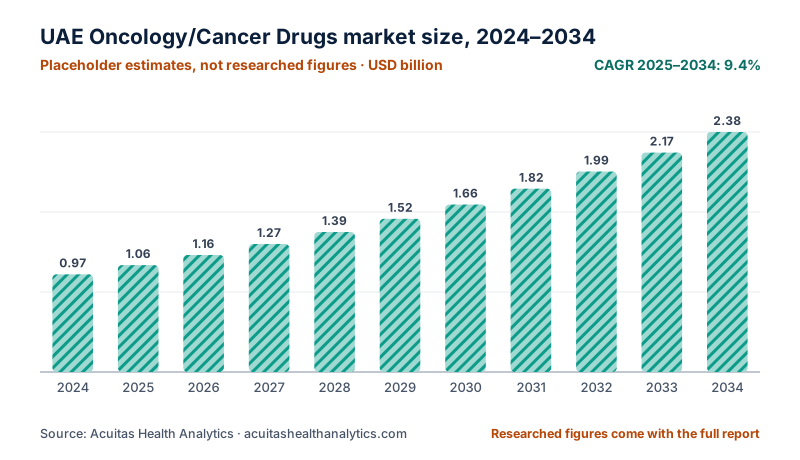
Estimate 2024$968.2 MnPlaceholder estimate
Estimate 2025$1.06 Bn0.5% of the global market
Projected 2034$2.38 Bn 124.5%Adds $1.32 Bn over 9 forecast years
CAGR 2025–20349.4%Faster than 55% of 183 Pharmaceuticals markets here
16 in the UAESource: ClinicalTrials.gov, Studies recruiting, active or not yet recruiting, in the UAE. Retrieved 9 Nov 2026.
Formats
PDF, PPTX, XLSX
Sizes and growth here are placeholder estimates, not researched figures. Researched figures come with the full report.
The UAE Oncology/Cancer Drugs Market Analysis Executive Summary
Cancer can be described as a disease that is classified by the rapid and uncontrollable division of the cells, which form tumours and may extend to another part of the body. It can occur in any organ or tissue of the body since trillions of cells exist in the body. Under normal circumstances, cell division is a controlled phenomenon by which new cells are formed to replace the old or damaged ones; no overgrowth occurs. However, when this process is prevented or interfered with, the cells multiply and develop into a mass and this can be cancerous or non-cancerous, making a tumour. In the year 2024, about 2,001,140 people are likely to be diagnosed with cancer in United States while 611,720 people will die because of this disease. Some of the widely used chemotherapy medications include Azacitidine, 5-Fluorouracil, Capecitabine, Gemcitabine, and Fludarabine, and they are very vital in combating different cancers and are almost always included in the chemo therapy protocols.
This global market is expanding at an impressive rate due to factors such as the rising incidences of cancer, increased human population, and improvements in the cancer treatment modalities. Current therapies such as chemotherapies and radiotherapies exist alongside other emerging therapies such as immunotherapies, targeted therapies and precision medicine. In regards to the emerging trends, there’s biomarkers for early detection and diagnostics through artificial intelligence. Nevertheless, the advancements in the market present certain drawbacks including high production costs, compliance with regulations and concerns regarding reimbursement structures. Regional differences are notable: North America has the largest market and is most advanced in terms of payment innovation, Europe has the most varied reimbursement models, and Asia-Pacific is the fastest-growing region. Many leading global pharmaceuticals and biotechnology companies engage in innovation with respect to the cancer market.
UAE Oncology/Cancer Drugs market size, 2024–2034. Placeholder estimates; researched figures come with the full report. Source: Acuitas Health Analytics.
UAE Oncology/Cancer Drugs Market Dynamics
Market Growth Drivers
The growth in the number of new oncological cases and the rising incidence of cancer among the elderly is another factor that contributes to the growth of the oncological business. And since people are living longer, more people are likely to contract the disease, creating demand for various forms of treatment. The immunotherapy and precision medicine are new innovations in technology that is helping the people with cancer to receive better treatment and have fewer side effects. This wave of innovation has strengthened by increased global research and development activities fuelled by increased investments in clinical trials and approval of new drugs by the leading pharmaceutical companies. Improved diagnostic techniques used in early detection also helps in treatment success since the earlier the intervention the better and more successful the treatment outcome. Other areas such as North America have a well-developed health system that also contributes to pervasiveness of such sophisticated therapies. This process, boosted by the COVID-19 pandemic, also introduced the use of telemedicine and distant monitoring in cancer treatment, which will remain a trend in the future. Also, there is a new therapeutic partnership between big pharma, biotech companies and healthcare providers that yields new innovative therapies to the patients, the oncology market is continuing to expand.
Opportunity
The trend of oncology market is highly dynamic due to innovations in the treatment methods for patients, immunotherapy, and digital technologies. Currently, the firms that are most effective at identifying and creating specific drug solutions as well as integrating multiple management approaches are likely to emerge as more competitive. The availability of telemedicine and early diagnostic measures, such as imaging and molecular biomarkers, are changing the landscape of cancer treatment. Higher levels of appropriations for research purposes are spurring the development of new treatments especially for severe diseases such as lungs and breast cancer. It may be seen that as the healthcare infrastructure strengthens in the developing regions such as Asia-Pacific and Latin America, there is the looming potential for global markets in the oncologist field.
Market Restraints
The oncology market faces numerous issues such as the high cost of promising therapies like immunotherapy that hinders patient access, particularly in LMICs. Potential regulatory barriers and the general and inelaborate nature of cancer make drug development costly and risky. Thus, competition within the market increases and decreases the profit margin, especially for set therapies that deal with generic competition. The lack of or poor access to healthcare in the developing world compounds these problems, which too frequently result in diagnosis and treatment. The pandemic has worsened the situation for cancer care, which disrupts the established market parameters due to delays. Furthermore, patients’ compliance issues that stem from treatment’s side effects and psychological aspects related to cancer further decrease the overall treatment efficacy and increase healthcare costs.
Competitive Landscape for Oncology/Cancer Drugs Market in the UAE
June 2024, Launch of Nutraceutical ‘AKTOCYTE’ by the Department of Atomic Energy Set to Transform Cancer Care
February 2024, Datopotamab deruxtecan Biologics License Application accepted in the US for patients with previously treated advanced nonsquamous non-small cell lung cancer.
Mergers and Acquisitions
January 2024, Johnson & Johnson announced it would acquire cancer drug developer Ambrx Biopharma for US$2 billion
January 2024, Merck announced its US$680 million buyout of Harpoon Therapeutics, strengthening the group’s pipeline of cancer treatments and counterbalancing the approaching loss of exclusivity on its immunotherapy treatment Keytruda.
Q4 2025, US drugmaker Eli Lilly enter the radiopharmaceuticals space through its US$1.4 billion acquisition of Point Biopharma. Eli Lilly paid a 90 percent premium for Point, whose radioligand therapy delivers radiation at close range to cancerous cells.
October 2025, US pharma giant Bristol Myers Squibb (BMS) announced its intention to acquire California-based oncology company Mirati Therapeutics for US$5.8 billion. Following the deal, the group will gain ownership of Mirati’s FDA-approved lung cancer drug, Krazati.
Healthcare Policies and Regulatory Landscape for Oncology/Cancer Drugs Market in the UAE
Oncology/Cancer Drugs in the UAE: rules, payment and research
The Emirates Drug Establishment (EDE), set up in 2023, is taking over the regulation of medicines from the Ministry of Health and Prevention.[1] Since January 2025, basic health insurance has been mandatory for all private-sector employees and domestic workers in every emirate.[2] ClinicalTrials.gov lists 16 studies on Oncology/Cancer Drugs that are recruiting, active or about to start in the UAE.[3]
[3]ClinicalTrials.gov, Studies recruiting, active or not yet recruiting, in the UAE. Retrieved 9 Nov 2026.
Policy changes and Reimbursement scenario
Several developed countries, as it will be demonstrated in the following section, have lately witnessed a shift towards a more rigorous regulation of drug prices and reimbursement policies. In the United Kingdom, the NHS is going through reform aimed at decentralizing decision making to the general practitioners; NICE is taking more advisory posts; and risk-sharing deals are on the increase due to high cost of medications. Germany implemented the AMNOG legislation, which includes cost-effectiveness assessments of newly launched drugs that influence pricing and market authorization, while France enhances the focus on therapeutic value and cost, as well as introduces the fast-track pre-application dossiers. While Norway and Sweden base reimbursement on disease severity, countries like Spain, Portugal, and Ireland are beginning to impose more rigorous control over expensive medical procedures due to budget shortages. Furthermore, cross-European collaboration in HTA has emerged as a necessity in order to strengthen the reliability of value assessment of new drugs.
Other companies that free public records show in this market: trials they lead, US approvals and WHO prequalification. They are not part of our key players research. Each count opens its source.
Also active in this area, from free public records
Source: ClinicalTrials.gov, Active studies (recruiting, about to start or running) each company leads, found with this market's trial search, worldwide. Retrieved 13 Nov 2026.
Source: Drugs@FDA, US approvals each company holds for medicines on the market whose FDA label lists this use. Retrieved 13 Nov 2026.
Beyond the market numbers
Research, trials and patients
What doctors and scientists are doing in Oncology/Cancer Drugs right now, from free public sources.
Sources:PubMed (US National Library of Medicine),
ClinicalTrials.gov,
World Bank.
Fetched 9 Nov 2026. Papers and trials are found by search words, so the counts are a guide. Titles only; read each paper at its source.
Public data, with sources
Oncology/Cancer Drugs in context
The UAE compared
Health spending per person: 2,402 US$ per person (2023). World: 1,317 US$ per person (2023). 2nd highest of the 10 countries we cover in Middle East.[1]
Doctors: 2.99 per 1,000 people (2023). World: 1.86 per 1,000 people (2022). 4th highest of the 10 countries we cover in Middle East.[2]
People aged 65 and over: 1.8% of people (2025). World: 10.4% of people (2025). 9th highest of the 10 countries we cover in Middle East.[3]
[1]World Bank Open Data, Health spending per person (US$ per person). Retrieved 20 Nov 2026.
How big is the Oncology/Cancer Drugs market in the UAE?
Placeholder estimate: about $1.06 Bn in 2025, rising to about $2.38 Bn by 2034. These are early estimates, not researched figures; the researched values come with the full report.
How fast is the Oncology/Cancer Drugs market in the UAE growing?
Placeholder estimate: about 9.4% a year (CAGR, 2025–2034). The researched growth rate comes with the full report.
What segments does the Oncology/Cancer Drugs market report cover?
The report splits the market by cancer diagnostics & treatment (Cancer Diagnostics, Cancer Treatment), cancer type (Breast Cancer, Lung Cancer, Prostate Cancer, Colon & Rectal Cancer and more) and end-user (Hospitals, Diagnostic Laboratories, Diagnostic Imaging Centers, Academia and more).
Who are the key players in the Oncology/Cancer Drugs market?
Key players include Roche, Bristol-Myers Squibb, Merck & Co., Inc., Johnson & Johnson, AstraZeneca and Pfizer Inc., among 7 companies the report profiles.
What is driving the Oncology/Cancer Drugs market?
The growth in the number of new oncological cases and the rising incidence of cancer among the elderly is another factor that contributes to the growth of the oncological business. And since people are living longer, more people are likely to contract the disease, creating demand for various forms of treatment.
Who regulates Oncology/Cancer Drugs in the UAE?
The Emirates Drug Establishment (EDE), set up in 2023, is taking over the regulation of medicines from the Ministry of Health and Prevention. Source: Emirates Drug Establishment. Checked 14 Nov 2026.
How is healthcare paid for in the UAE?
Since January 2025, basic health insurance has been mandatory for all private-sector employees and domestic workers in every emirate. Source: Ministry of Human Resources and Emiratisation. Checked 14 Nov 2026.
How many clinical trials on Oncology/Cancer Drugs are running in the UAE?
16 studies are recruiting, active or about to start in the UAE, according to ClinicalTrials.gov. Source: ClinicalTrials.gov, Studies recruiting, active or not yet recruiting, in the UAE. Retrieved 9 Nov 2026.
How much research is published on Oncology/Cancer Drugs?
PubMed lists 342,719 papers on Oncology/Cancer Drugs added since January 2021, worldwide. Source: PubMed, Papers added since 1 January 2021 matching this market. Retrieved 9 Nov 2026.
 UAE



 Saudi Arabia
 US
 China
 Canada
 Japan
 Germany
 France
 UK
 Brazil
 Italy
 Ecuador
 Spain
 India
 Mexico
 Australia
 South Africa
 Egypt
 Philippines
 Malaysia
 Hong Kong
 Singapore
 Thailand
 Kenya
 Pfizer
 Novartis
 Hikma Pharmaceuticals PLC
 Fresenius SE & CO
 AbbVie Inc.
 Viatris
 Amneal Pharmaceuticals, Inc