 ResMed Inc.
 PepsiCo
Ecuador at a glance
- Population
- 18.3 million 2025
- Life expectancy at birth
- 77.6 years, 2024
- People aged 65 and over
- 8.6 % of people, 2025
- Health spending per person
- 509 US$ per person, 2023
- Doctors
- 2.31 per 1,000 people, 2020
 Ecuador
Updated
 Reviewed by Chandani Patel
Ecuador Wearable Healthcare Devices Market Analysis Industry Trends and Forecast to 2034: Segmented by (By Product, By Type, By Grade, By Distribution Channel, By Application, By Region) - Growth, Market Size, Future Prospects & Competitive Analysis, 2024-2034
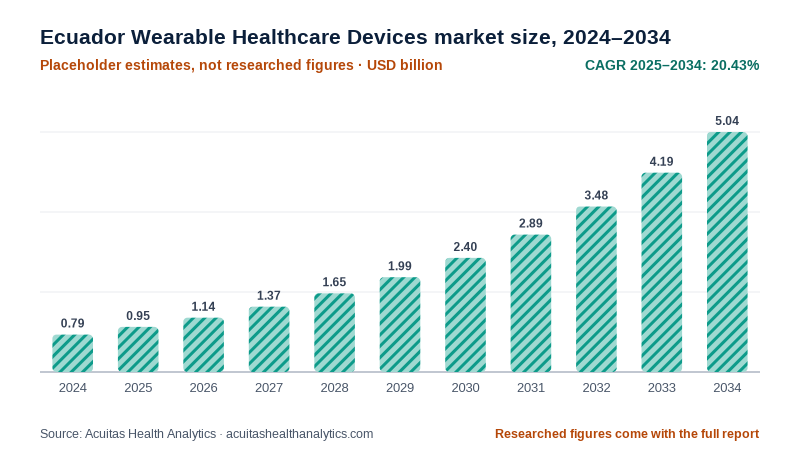
Ecuador · 2024–2034 · placeholder estimates
Values shown here are placeholder estimates, not researched figures. Researched 2024 historical, 2025 base-year and 2026–2034 forecast values are prepared with the full report.
 Brazil at $1.19 Bn. Brazil at 20.8% a year.
Source: Acuitas Health Analytics. Full methods, sources and usage terms come with report purchase.
$4.09 Bn total, 2026–2034
| Year | Market size | Change that year | Since 2025 |
|---|---|---|---|
| 2024 (estimate) | $785.9 Mn | — | — |
| 2025 (base) | $946.4 Mn | +$160.5 Mn | — |
| 2026 (forecast) | $1.14 Bn | +$193.3 Mn | +20.4% |
| 2027 (forecast) | $1.37 Bn | +$232.8 Mn | +45% |
| 2028 (forecast) | $1.65 Bn | +$280.3 Mn | +74.6% |
| 2029 (forecast) | $1.99 Bn | +$337.6 Mn | +110.3% |
| 2030 (forecast) | $2.40 Bn | +$406.5 Mn | +153.3% |
| 2031 (forecast) | $2.89 Bn | +$489.6 Mn | +205% |
| 2032 (forecast) | $3.48 Bn | +$589.6 Mn | +267.3% |
| 2033 (forecast) | $4.19 Bn | +$710.0 Mn | +342.3% |
| 2034 (forecast) | $5.04 Bn | +$855.0 Mn | +432.7% |
Placeholder estimates. Each year is projected from our earlier market estimate and its CAGR. Researched values come with the full report.
 US
$19.02 Bn
 China
$3.86 Bn
 Canada
$3.75 Bn
 Japan
$2.94 Bn
 Germany
$1.66 Bn
 France
$1.27 Bn
 UK
$1.18 Bn
Brazil
$1.19 Bn
 Italy
$1.11 Bn
Ecuador (this report)
$946.4 Mn
 Spain
$888.9 Mn
 India
$894.8 Mn
 Saudi Arabia
$816.2 Mn
 Mexico
$705.3 Mn
 Australia
$576.2 Mn
 South Africa
$310.7 Mn
 UAE
$238.2 Mn
 Egypt
$134.5 Mn
 Philippines
$103.9 Mn
 Malaysia
$75.6 Mn
 Hong Kong
$76.3 Mn
 Singapore
$56.8 Mn
 Thailand
$56.6 Mn
 Kenya
$33.3 Mn
| Market size, 2025 | $946.4 Mn placeholder estimate |
|---|---|
| Forecast, 2034 | $5.04 Bn placeholder estimate |
| Growth (CAGR), 2025–2034 | 20.43% placeholder estimate |
| Years | 2024 historical · 2025 base year · 2026–2034 forecast |
| Segments | Product, type, grade, distribution channel and application (see all) |
| Key players | Apple Inc., Fitbit Inc., Abbott Laboratories, Dexcom, Inc., Koninklijke Philips N.V. and 5 more (see all) |
| Formats | PDF, PPTX, XLSX |
Sizes and growth here are placeholder estimates, not researched figures. Researched figures come with the full report.
Wearable healthcare on the other hand deals with portable health care products that are put on the body of the user to track his health status; for instance, smartwatches. These devices employ several detectors like biosensors to capture multiple parameters like heart rate, blood pressure, sleeping cycle, and movement from the patient. Other devices monitor, identify abnormalities, and inform the user and relevant medical team, if any, about the data.
The market for wearable healthcare devices is emerging briskly due to social factors like technological innovation, awareness, and the rising rates of chronic diseases. This market ranges from wearables such as fitness trackers, smartwatches to niche products including ECG and blood glucose monitors. Both rising aging population and fundamental for constant health check-ups due to persistent illnesses are the aspects behind its growth. Advancements in artificial intelligence, biosensors, and connectivity are bringing improvements to the devices but factors such as data privacy, approval issues, and high costs present challenges. About the future of this market, it is possible to state that it is going to be personalized care and better integration with the world of healthcare.
One of the trends that has emerged is the need to monitor one’s health through real time data as consumers seek services that will allow them to monitor their health status. The use of AI and ML in wearables boosts data interpretation and offers users relevant suggestions, thus improving interaction levels. Telemedicine, on the same, has also been embraced due to COVID-19 outbreak as a way of cutting on face-to-face consultations. Further, the aging global population and growing incidence of chronic disorders, including diabetes, are driving the demand for wearable devices. These trends are expected to persist in the subsequent years in fostering market growth.
New functions could appear in the future when new smartwatches, fitness trackers, patches, and smart clothing are introduced to the public as they may be improved in terms of health monitoring and management. Such gadgets could eventually provide more targeted health-related products, services, or treatments for certain diseases or for all chronic diseases required by patients with specific requirements or preferences. Moreover, with the increasing use of remote patient monitoring and home healthcare, wearable devices can be a primary asset for monitoring and caring for patients with chronic diseases and the elderly.
Lack of consistency in the regulation across different geographical locations makes it challenging to determine the safety and effectiveness of devices, which, in turn, may hamper the growth of the market. The study on wearable-generated data quality questions the credibility of the information and points to wrong primary diagnosis and treatment choices, stressing the importance of data integrity. Data security/privacy is also an important factor, as consumers do not want to disclose their health data due to risks associated with data leakage. Two other challenges include limited battery life of the device and the challenge of designing wearable devices that are not only technologically effective but also fashionable. Additional difficulties arise to sustain competitiveness in the sphere due to these challenges of protecting patents.
Key Players
 Apple Inc.
 Fitbit Inc.
 Dexcom
 Koninklijke Philips N.V.
 Alphabet Inc.
 Xiaomi
 Samsung Electronics
 Garmin
July 2024, Samsung Launches AI Wearable Device for Personalized Health. South Korean electronics company Samsung has unveiled its latest wearable devices, the Galaxy Watch Ultra and the Galaxy Ring, aiming to capitalize on the mass adoption of personalized health technology.
February 2024, Apple engineers planned three smart wearable devices, including a ring. Apple may have explored developing ring, smart glasses, Air Pods with cameras, AI and health Sensors. Cameras on Earbuds could offer smart glasses without lenses and frames.
December 2025, New Wearable In-Ear Medical Device Helps Sufferers of Standing-Related Ailments. US biotechnology company STAT Health Informatics in Boston, which has developed a wearable device that monitors blood flow to the ear and face to better understand symptoms such as dizziness, brain fog, headaches, fainting, and fatigue that occur upon standing. The tiny device is worn in the ear and connects wirelessly to a smartphone app.
September 2025, Indian start-up launches wearable smart ring. The ring works with the Bonatra app and continuous glucose monitors to track multiple health parameters.
June 2025, Cala Health recently launched its kIQ system - which it calls the first non-invasive wearable device cleared by the FDA to temporarily relieve tremors in people with essential tremor and Parkinson’s disease.
January 2025, Philips and Masimo expand partnership to improve telehealth for patients and clinicians around the world. Breakthrough combination of the Masimo W1 Watch with advanced Philips solutions will soon be available for home telehealth applications.
January 2021, Google completed Fitbit acquisition. A clear pioneer in the industry, Fitbit built a vibrant community of more than 29 million active users by creating amazing wearable devices and immersive wellness experiences.
January 2021, Philips Acquires BioTelemetry and Its Wearable Remote Heart Monitors.
The Ministry of Public Health runs free public care, and the Ecuadorian Social Security Institute (IESS) covers formal workers.[1]
[1] Ministry of Public Health of Ecuador. Checked 14 Nov 2026.
Authorities such as the FDA are beginning to establish more concrete criteria to categorize some smart clothes as medical, thus guaranteeing their effectiveness and safety. The policymakers are also encouraging the use of wearables as part of the EHRs for better functionality and increase in patient’s status. The COVID-19 pandemic has pushed for remote patient monitoring, resulting in friendly policies for telehealth depending on wearables. But today, due to the policies of reimbursement, it is low and available selectively depriving many potential users from its benefits. The move towards value-based renumeration where the fee paid to providers is based on the health outcomes of patients means that wearables that promote better health outcomes may be deemed as reasonable and necessary for coverage.
What doctors and scientists are doing in Wearable Healthcare Devices right now, from free public sources.
Sources: PubMed (US National Library of Medicine), ClinicalTrials.gov, World Bank. Fetched 9 Nov 2026. Papers and trials are found by search words, so the counts are a guide. Titles only; read each paper at its source.
[1] World Bank Open Data, Health spending per person (US$ per person). Retrieved 25 Nov 2026.
[2] World Bank Open Data, Doctors (per 1,000 people). Retrieved 24 Nov 2026.
[3] World Bank Open Data, People aged 65 and over (% of people). Retrieved 24 Nov 2026.
From our blog
Ecuador · 3 shared keywords
Ecuador · 2 shared keywords
Ecuador · 2 shared keywords
Ecuador · 2 shared keywords
Ecuador · 2 shared keywords
Ecuador · 1 shared keyword
OTC & Nutraceuticals · Ecuador
Medical Devices · Ecuador
Medical Devices · Ecuador
OTC & Nutraceuticals · Ecuador
Medical Devices · Ecuador
Medical Devices · Ecuador