APAC Wearable Healthcare Devices Market Analysis Industry Trends and Forecast to 2034: Segmented by (By Product, By Type, By Grade, By Distribution Channel, By Application, By Region) - Growth, Market Size, Future Prospects & Competitive Analysis, 2024-2034
Overview
Market Dashboard
APAC · 2024–2034 · placeholder estimates
Values shown here are placeholder estimates, not researched figures. Researched 2024 historical, 2025 base-year and 2026–2034 forecast values are prepared with the
full report.
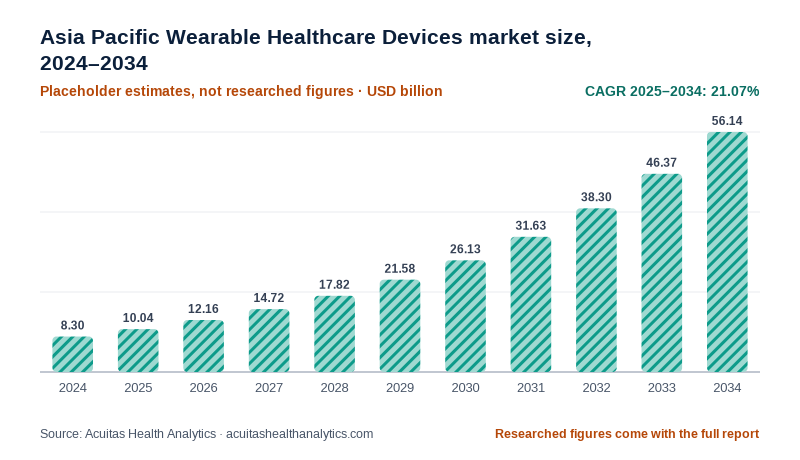
Estimate 2024$8.30 BnPlaceholder estimate
Estimate 2025$10.04 Bn21.4% of the global market
Projected 2034$56.14 Bn 458.9%Adds $46.09 Bn over 9 forecast years
CAGR 2025–203421.07%Faster than 66% of 104 Digital Health markets here
APAC Wearable Healthcare Devices Market Analysis at a glance
Market size, 2025
$10.04 Bn placeholder estimate
Forecast, 2034
$56.14 Bn placeholder estimate
Growth (CAGR), 2025–2034
21.07% placeholder estimate
Years
2024 historical · 2025 base year · 2026–2034 forecast
Segments
Product, type, grade, distribution channel and application (see all)
Key players
Apple Inc., Fitbit Inc., Abbott Laboratories, Dexcom, Inc., Koninklijke Philips N.V. and 5 more (see all)
Active clinical trials
195 in Asia PacificSource: ClinicalTrials.gov, Studies recruiting, active or not yet recruiting, in Asia Pacific. Retrieved 9 Nov 2026.
Formats
PDF, PPTX, XLSX
Sizes and growth here are placeholder estimates, not researched figures. Researched figures come with the full report.
The APAC Wearable Healthcare Devices Market Executive Summary
Wearable healthcare on the other hand deals with portable health care products that are put on the body of the user to track his health status; for instance, smartwatches. These devices employ several detectors like biosensors to capture multiple parameters like heart rate, blood pressure, sleeping cycle, and movement from the patient. Other devices monitor, identify abnormalities, and inform the user and relevant medical team, if any, about the data.
The market for wearable healthcare devices is emerging briskly due to social factors like technological innovation, awareness, and the rising rates of chronic diseases. This market ranges from wearables such as fitness trackers, smartwatches to niche products including ECG and blood glucose monitors. Both rising aging population and fundamental for constant health check-ups due to persistent illnesses are the aspects behind its growth. Advancements in artificial intelligence, biosensors, and connectivity are bringing improvements to the devices but factors such as data privacy, approval issues, and high costs present challenges. About the future of this market, it is possible to state that it is going to be personalized care and better integration with the world of healthcare.
Asia Pacific Wearable Healthcare Devices market size, 2024–2034. Placeholder estimates; researched figures come with the full report. Source: Acuitas Health Analytics.
APAC Wearable Healthcare Devices Market Dynamics
Market Growth Drivers
One of the trends that has emerged is the need to monitor one’s health through real time data as consumers seek services that will allow them to monitor their health status. The use of AI and ML in wearables boosts data interpretation and offers users relevant suggestions, thus improving interaction levels. Telemedicine, on the same, has also been embraced due to COVID-19 outbreak as a way of cutting on face-to-face consultations. Further, the aging global population and growing incidence of chronic disorders, including diabetes, are driving the demand for wearable devices. These trends are expected to persist in the subsequent years in fostering market growth.
Opportunity
New functions could appear in the future when new smartwatches, fitness trackers, patches, and smart clothing are introduced to the public as they may be improved in terms of health monitoring and management. Such gadgets could eventually provide more targeted health-related products, services, or treatments for certain diseases or for all chronic diseases required by patients with specific requirements or preferences. Moreover, with the increasing use of remote patient monitoring and home healthcare, wearable devices can be a primary asset for monitoring and caring for patients with chronic diseases and the elderly.
Market Restraints
Lack of consistency in the regulation across different geographical locations makes it challenging to determine the safety and effectiveness of devices, which, in turn, may hamper the growth of the market. The study on wearable-generated data quality questions the credibility of the information and points to wrong primary diagnosis and treatment choices, stressing the importance of data integrity. Data security/privacy is also an important factor, as consumers do not want to disclose their health data due to risks associated with data leakage. Two other challenges include limited battery life of the device and the challenge of designing wearable devices that are not only technologically effective but also fashionable. Additional difficulties arise to sustain competitiveness in the sphere due to these challenges of protecting patents.
Competitive Landscape for Wearable Healthcare Devices Market in APAC
July 2024, Samsung Launches AI Wearable Device for Personalized Health. South Korean electronics company Samsung has unveiled its latest wearable devices, the Galaxy Watch Ultra and the Galaxy Ring, aiming to capitalize on the mass adoption of personalized health technology.
February 2024, Apple engineers planned three smart wearable devices, including a ring. Apple may have explored developing ring, smart glasses, Air Pods with cameras, AI and health Sensors. Cameras on Earbuds could offer smart glasses without lenses and frames.
December 2025, New Wearable In-Ear Medical Device Helps Sufferers of Standing-Related Ailments. US biotechnology company STAT Health Informatics in Boston, which has developed a wearable device that monitors blood flow to the ear and face to better understand symptoms such as dizziness, brain fog, headaches, fainting, and fatigue that occur upon standing. The tiny device is worn in the ear and connects wirelessly to a smartphone app.
September 2025, Indian start-up launches wearable smart ring. The ring works with the Bonatra app and continuous glucose monitors to track multiple health parameters.
June 2025, Cala Health recently launched its kIQ system - which it calls the first non-invasive wearable device cleared by the FDA to temporarily relieve tremors in people with essential tremor and Parkinson’s disease.
Mergers and Acquisitions
January 2025, Philips and Masimo expand partnership to improve telehealth for patients and clinicians around the world. Breakthrough combination of the Masimo W1 Watch with advanced Philips solutions will soon be available for home telehealth applications.
January 2021, Google completed Fitbit acquisition. A clear pioneer in the industry, Fitbit built a vibrant community of more than 29 million active users by creating amazing wearable devices and immersive wellness experiences.
January 2021, Philips Acquires BioTelemetry and Its Wearable Remote Heart Monitors.
Healthcare Policies and Regulatory Landscape for Wearable Healthcare Devices Market in APAC
Wearable Healthcare Devices in APAC: rules, payment and research
In some of the countries we cover here, rules for health software come from TGA (Australia)[1], NMPA (China)[2], PMDA (Japan)[3] and MFDS (South Korea)[4]. How care is paid for in some of these countries: Medicare and the PBS (Australia)[5], basic medical insurance (China)[6], the Hospital Authority (Hong Kong)[7], Ayushman Bharat PM-JAY (India)[8], public health insurance (Japan)[9], subsidised public care (Malaysia)[10], Pharmac (New Zealand)[11], PhilHealth (Philippines)[12], MediShield Life (Singapore)[13], the Universal Coverage Scheme (Thailand)[14], JKN (BPJS Kesehatan) (Indonesia)[15], out of pocket and Sehat Sahulat (Pakistan)[16], National Health Insurance (South Korea)[17] and social health insurance (Vietnam)[18]. ClinicalTrials.gov lists 195 studies on Wearable Healthcare Devices that are recruiting, active or about to start in APAC.[19]
[19]ClinicalTrials.gov, Studies recruiting, active or not yet recruiting, in APAC. Retrieved 9 Nov 2026.
Policy changes and Reimbursement scenario
Authorities such as the FDA are beginning to establish more concrete criteria to categorize some smart clothes as medical, thus guaranteeing their effectiveness and safety. The policymakers are also encouraging the use of wearables as part of the EHRs for better functionality and increase in patient’s status. The COVID-19 pandemic has pushed for remote patient monitoring, resulting in friendly policies for telehealth depending on wearables. But today, due to the policies of reimbursement, it is low and available selectively depriving many potential users from its benefits. The move towards value-based renumeration where the fee paid to providers is based on the health outcomes of patients means that wearables that promote better health outcomes may be deemed as reasonable and necessary for coverage.
8.2 Government Initiatives / Intervention programs
The wearable healthcare devices market can be segmented into several categories based on various criteria. Here’s a detailed overview of the market segmentation:
Other companies that free public records show in this market: trials they lead, US approvals and WHO prequalification. They are not part of our key players research. Each count opens its source.
Also active in this area, from free public records
Source: ClinicalTrials.gov, Active studies (recruiting, about to start or running) each company leads, found with this market's trial search, worldwide. Retrieved 13 Nov 2026.
Source: FDA 510(k) and PMA databases, 510(k) clearances and PMA approvals since 2015 for devices whose name has this market's words. Retrieved 13 Nov 2026.
Beyond the market numbers
Research, trials and patients
What doctors and scientists are doing in Wearable Healthcare Devices right now, from free public sources.
Clinical trials
195 active trials in China, India, Japan, South Korea, Australia, Hong Kong, Philippines, Singapore, Thailand, Vietnam, Malaysia, New Zealand, Bangladesh, Afghanistan, Indonesia, Myanmar, Nepal and Pakistan
Recruiting, about to start, or running now. Counted across the 18 countries we report on in APAC.
Sources:PubMed (US National Library of Medicine),
ClinicalTrials.gov.
Fetched 9 Nov 2026. Papers and trials are found by search words, so the counts are a guide. Titles only; read each paper at its source.
How big is the Wearable Healthcare Devices market in Asia Pacific?
Placeholder estimate: about $10.04 Bn in 2025, rising to about $56.14 Bn by 2034. These are early estimates, not researched figures; the researched values come with the full report.
How fast is the Wearable Healthcare Devices market in Asia Pacific growing?
Placeholder estimate: about 21.07% a year (CAGR, 2025–2034). The researched growth rate comes with the full report.
What segments does the Wearable Healthcare Devices market report cover?
The report splits the market by product (Trackers, Smartwatches, Patches, Smart Clothing), type (Diagnostic Devices, Therapeutic Devices), grade (Consumer-grade Wearable Healthcare Devices, Clinical-grade Wearable Healthcare Devices) and distribution channel (Online Channels, Pharmacies, Hypermarkets).
Who are the key players in the Wearable Healthcare Devices market?
Key players include Apple Inc., Fitbit Inc., Abbott Laboratories, Dexcom, Inc., Koninklijke Philips N.V. and Alphabet Inc., among 10 companies the report profiles.
What is driving the Wearable Healthcare Devices market?
One of the trends that has emerged is the need to monitor one’s health through real time data as consumers seek services that will allow them to monitor their health status. The use of AI and ML in wearables boosts data interpretation and offers users relevant suggestions, thus improving interaction levels.
How many clinical trials on Wearable Healthcare Devices are running in Asia Pacific?
195 studies are recruiting, active or about to start in Asia Pacific, counted across the 18 countries we report on there, according to ClinicalTrials.gov. Source: ClinicalTrials.gov, Studies recruiting, active or not yet recruiting, in Asia Pacific. Retrieved 9 Nov 2026.
How much research is published on Wearable Healthcare Devices?
PubMed lists 21,888 papers on Wearable Healthcare Devices added since January 2021, worldwide. Source: PubMed, Papers added since 1 January 2021 matching this market. Retrieved 9 Nov 2026.



 US
 China
 Canada
 Japan
 Germany
 France
 UK
 Brazil
 Italy
 Ecuador
 Spain
 India
 Saudi Arabia
 Mexico
 Australia
 South Africa
 UAE
 Egypt
 Philippines
 Malaysia
 Hong Kong
 Singapore
 Thailand
 Kenya
 Xiaomi
 Samsung Electronics
 Garmin
 ResMed Inc.
 PepsiCo