Hong Kong Dermatology Diagnostic Market Industry Trends and Forecast to 2034: Segmented by (Product, Application, End-user, Region) - Growth, Market Size, Future Prospects & Competitive Analysis, 2024-2034
Overview
Market Dashboard
Hong Kong · 2024–2034 · placeholder estimates
Values shown here are placeholder estimates, not researched figures. Researched 2024 historical, 2025 base-year and 2026–2034 forecast values are prepared with the
full report.
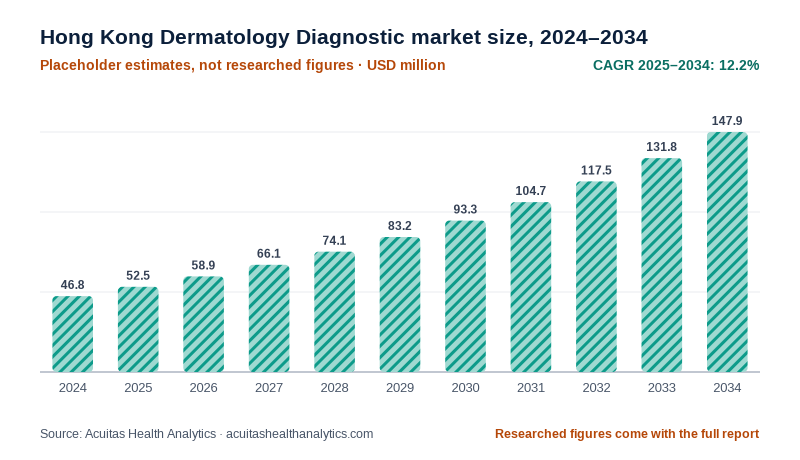
Estimate 2024$46.8 MnPlaceholder estimate
Estimate 2025$52.5 Mn0.2% of the global market
Projected 2034$147.9 Mn 181.8%Adds $95.4 Mn over 9 forecast years
CAGR 2025–203412.2%Faster than 71% of 116 Healthcare Services markets here
Cynosure Inc., Valeant Pharmaceuticals, Genentech Inc., Alma Lasers Ltd., Galderma S.A. and 5 more (see all)
Active clinical trials
47 in Hong KongSource: ClinicalTrials.gov, Studies recruiting, active or not yet recruiting, in Hong Kong. Retrieved 9 Nov 2026.
Formats
PDF, PPTX, XLSX
Sizes and growth here are placeholder estimates, not researched figures. Researched figures come with the full report.
The Hong Kong Dermatology Diagnostic Market Analysis Executive Summary
The dermatology diagnostic market encompasses a range of technologies and methodologies aimed at diagnosing skin conditions, including skin cancers, psoriasis, eczema, and acne. This market has evolved significantly due to advancements in imaging technologies, artificial intelligence (AI), and teledermatology, which have improved diagnostic accuracy and patient access to care.
The increasing prevalence of skin disorders, coupled with a rising awareness of skin health, is driving this growth. Moreover, the COVID-19 pandemic has accelerated the adoption of digital health solutions, including telemedicine and remote diagnostic tools, enabling patients to receive timely care without in-person visits.
Hong Kong Dermatology Diagnostic market size, 2024–2034. Placeholder estimates; researched figures come with the full report. Source: Acuitas Health Analytics.
Hong Kong Dermatology Diagnostic Market Dynamics
Market Growth Drivers
Rising Incidence of Skin Disorders: The prevalence of skin conditions such as melanoma, non-melanoma skin cancers, and chronic inflammatory skin diseases is increasing globally. For instance, skin cancer rates have been rising, with melanoma cases expected to increase by 5% annually.
Technological Advancements: Innovations in diagnostic tools, such as dermatoscopes, reflectance confocal microscopy, and AI-powered image analysis, have enhanced the accuracy and speed of skin disease diagnosis. AI algorithms can analyze images with high precision, assisting dermatologists in making informed decisions.
Increased Awareness and Preventive Care: Growing public awareness about skin health and the importance of early diagnosis has led to more individuals seeking dermatological care. Campaigns promoting skin cancer awareness have significantly increased screening rates.
Opportunity
The dermatology diagnostic market is witnessing the entry of new players, including startups focusing on AI-driven diagnostics and teledermatology platforms. Partnerships between technology companies and healthcare providers are becoming more common, exemplified by collaborations like that of IBM Watson Health with dermatology clinics to enhance diagnostic capabilities.
Additionally, regulatory bodies are easing approval processes for innovative diagnostic tools, which is vital for market expansion. For instance, the U.S. Food and Drug Administration (FDA) has introduced expedited pathways for digital health products, facilitating quicker access to the market for new diagnostic technologies.
Market Restraints
The dermatology diagnostic market faces several restraints that can impact its growth and development. These challenges include:
High Cost of Procedures: The diagnosis and treatment of skin disorders often involve significant expenses, which can deter patients from seeking necessary care. The high costs associated with advanced diagnostic devices and procedures can limit accessibility, particularly in lower-income regions or for uninsured patients.
Stringent Regulatory Policies: Regulatory agencies, such as the FDA and EMA, impose rigorous standards for the approval of dermatological devices. This can result in lengthy approval processes and increased costs for manufacturers, potentially slowing down the introduction of innovative diagnostic solutions to the market.
Market Competition from Alternative Treatments: The availability of non-invasive or minimally invasive treatment options, such as chemical peels and light therapies, presents competition to traditional dermatological diagnostic devices. These alternatives often offer effective results with reduced discomfort and recovery time, making them appealing to patients.
These restraints highlight the complexities and challenges within the dermatology diagnostic market, necessitating strategic approaches from stakeholders to navigate these obstacles effectively.
Competitive Landscape for Dermatology Diagnostic Market in Hong Kong
In October 2025, Better Therapeutics, Inc. has launched AspyreRx, the first cognitive behavioral therapy (CBT) app aimed at treating adults with type 2 diabetes (T2D).
In July 2022, AmerisourceBergen has launched DTx Connect, a comprehensive platform designed to streamline the ordering, dispensing, and fulfillment of physician-prescribed Dermatology Diagnostic and diagnostics, enhancing patient access.
Mergers and Acquisitions
In February 2025, JOLLY GOOD Inc. and TEIJIN LIMITED announced a partnership to develop virtual reality solutions in this market for major depressive disorders.
In August 2022, Akili Inc., the maker of a video game-like digital therapeutic for children with ADHD, announced the merger with a special-purpose acquisition company Social Capital Suvretta Holdings Corp.
Healthcare Policies and Regulatory Landscape for Dermatology Diagnostic Market in Hong Kong
Dermatology Diagnostic in Hong Kong: payment and research
Public hospitals and clinics, run by the Hospital Authority, are heavily subsidised by the government.[1] ClinicalTrials.gov lists 47 studies on Dermatology Diagnostic that are recruiting, active or about to start in Hong Kong.[2]
[2]ClinicalTrials.gov, Studies recruiting, active or not yet recruiting, in Hong Kong. Retrieved 9 Nov 2026.
Policy Changes and Reimbursement Scenario
Encouraging regulatory changes in healthcare policies for dermatology diagnostics are emerging, particularly in the U.S. The Centers for Medicare & Medicaid Services (CMS) is exploring new codes in the upcoming Medicare Physician Fee Schedule to cover reimbursement for digital dermatology diagnostic tools, including those that utilize advanced imaging technologies. This is a positive development for dermatology diagnostic companies, as it allows billing for clinician time spent on services related to these diagnostics, provided the technologies are FDA-approved.
In Europe, regulatory bodies are beginning to recognize the importance of integrating digital dermatology diagnostics into healthcare systems. Countries like Germany are still developing frameworks to support these innovations, while France and Belgium are more advanced in their implementation. The European Medicines Agency (EMA) is working on guidelines for the assessment and approval of digital health technologies. However, reimbursement remains a significant challenge, as many payers are hesitant to cover dermatology diagnostics unless their cost-effectiveness is well-documented.
8.2 Government Initiatives / Intervention programs
The dermatology diagnostic market is segmented into the following categories: Application, End-user, and Region. This segmentation provides insights into growth areas and assists stakeholders in strategic decision-making regarding market applications.
By Product
Dermatology diagnostics devices, by Type Dermatoscopes Microscopes Imaging Devices
Dermatology treatment devices, by Type Light Therapy Devices Lasers Electrosurgical Equipment Liposuction Devices Microdermabrasion Devices Cryotherapy Devices
By Application
Dermatology diagnostics devices, by Application Skin Cancer Diagnosis Other Diagnostic Applications
Dermatology treatment devices, by Application Hair Removal Skin Rejuvenation Acne, Psoriasis, and Tattoo Removal Wrinkle Removal and Skin Resurfacing Body Contouring and Fat Removal Vascular and Pigmented Lesion Removal Warts, Skin Tags, and Weight Manage
Other companies that free public records show in this market: trials they lead, US approvals and WHO prequalification. They are not part of our key players research. Each count opens its source.
Also active in this area, from free public records
Source: ClinicalTrials.gov, Active studies (recruiting, about to start or running) each company leads, found with this market's trial search, worldwide. Retrieved 13 Nov 2026.
Source: FDA 510(k) and PMA databases, 510(k) clearances and PMA approvals since 2015 for devices whose name has this market's words. Retrieved 13 Nov 2026.
Beyond the market numbers
Research, trials and patients
What doctors and scientists are doing in Dermatology Diagnostic right now, from free public sources.
Sources:PubMed (US National Library of Medicine),
ClinicalTrials.gov,
World Bank.
Fetched 9 Nov 2026. Papers and trials are found by search words, so the counts are a guide. Titles only; read each paper at its source.
Public data, with sources
Dermatology Diagnostic in context
Hong Kong compared
People aged 65 and over: 23.7% of people (2025). World: 10.4% of people (2025). 2nd highest of the 18 countries we cover in APAC.[1]
[1]World Bank Open Data, People aged 65 and over (% of people). Retrieved 27 Nov 2026.
How big is the Dermatology Diagnostic market in Hong Kong?
Placeholder estimate: about $52.5 Mn in 2025, rising to about $147.9 Mn by 2034. These are early estimates, not researched figures; the researched values come with the full report.
How fast is the Dermatology Diagnostic market in Hong Kong growing?
Placeholder estimate: about 12.2% a year (CAGR, 2025–2034). The researched growth rate comes with the full report.
What segments does the Dermatology Diagnostic market report cover?
The report splits the market by product (Dermatology diagnostics devices, by Type Dermatoscopes Microscopes Imaging Devices, Dermatology treatment devices, by Type Light Therapy Devices Lasers Electrosurgical Equipment Liposuction Devices Microdermabrasion Devices Cryotherapy Devices), application (Dermatology diagnostics devices, by Application Skin Cancer Diagnosis Other Diagnostic Applications, Dermatology treatment devices, by Application Hair Removal Skin Rejuvenation Acne, Psoriasis, and Tattoo Removal Wrinkle Removal and Skin Resurfacing Body Contouring and Fat Removal Vascular and Pigmented Lesion Removal Warts, Skin Tags, and Weight Manage) and end-user (Hospitals, Specialty Dermatology Clinics, Private Clinics, Research Institutions and more).
Who are the key players in the Dermatology Diagnostic market?
Key players include Cynosure Inc., Valeant Pharmaceuticals, Genentech Inc., Alma Lasers Ltd., Galderma S.A. and DermTech, among 10 companies the report profiles.
What is driving the Dermatology Diagnostic market?
Rising Incidence of Skin Disorders: The prevalence of skin conditions such as melanoma, non-melanoma skin cancers, and chronic inflammatory skin diseases is increasing globally. For instance, skin cancer rates have been rising, with melanoma cases expected to increase by 5% annually.
How is healthcare paid for in Hong Kong?
Public hospitals and clinics, run by the Hospital Authority, are heavily subsidised by the government. Source: Hospital Authority. Checked 14 Nov 2026.
How many clinical trials on Dermatology Diagnostic are running in Hong Kong?
47 studies are recruiting, active or about to start in Hong Kong, according to ClinicalTrials.gov. Source: ClinicalTrials.gov, Studies recruiting, active or not yet recruiting, in Hong Kong. Retrieved 9 Nov 2026.
How much research is published on Dermatology Diagnostic?
PubMed lists 27,005 papers on Dermatology Diagnostic added since January 2021, worldwide. Source: PubMed, Papers added since 1 January 2021 matching this market. Retrieved 9 Nov 2026.
 Hong Kong



 China
 India
 US
 Canada
 Japan
 Germany
 France
 UK
 Brazil
 Italy
 Ecuador
 Spain
 Saudi Arabia
 Mexico
 Australia
 South Africa
 UAE
 Egypt
 Philippines
 Malaysia
 Singapore
 Thailand
 Kenya
 AbbVie Inc.
 Medytox Inc.
 PathologyWatch
 AstraZeneca
 Novartis AG
 Merck & Co., Inc.
 Pfizer Inc.