 Medtronic
Patients
2.9 per 100,000 people
Suicide rate, UAE, 2023 (WHO).
Compare every country on the Public Health Dashboard UAE
Updated
 Reviewed by Chandani Patel
UAE Mental Health Wearables Market Industry Trends and Forecast to 2034: Segmented by (Product, Use, End User, Region) - Growth, Market Size, Future Prospects & Competitive Analysis, 2024-2034
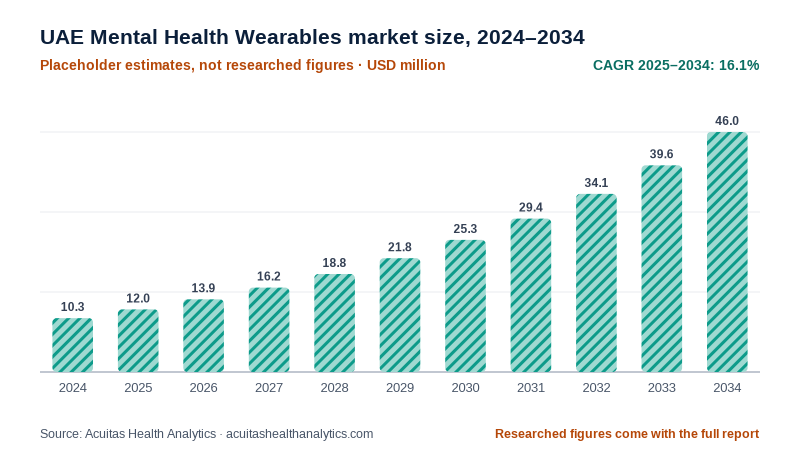
UAE · 2024–2034 · placeholder estimates
Values shown here are placeholder estimates, not researched figures. Researched 2024 historical, 2025 base-year and 2026–2034 forecast values are prepared with the full report.


 Saudi Arabia at $40.0 Mn. Saudi Arabia at 16.1% a year.
Source: Acuitas Health Analytics. Full methods, sources and usage terms come with report purchase.
$34.0 Mn total, 2026–2034
| Year | Market size | Change that year | Since 2025 |
|---|---|---|---|
| 2024 (estimate) | $10.3 Mn | — | — |
| 2025 (base) | $12.0 Mn | +$1.7 Mn | — |
| 2026 (forecast) | $13.9 Mn | +$1.9 Mn | +16.1% |
| 2027 (forecast) | $16.2 Mn | +$2.2 Mn | +34.8% |
| 2028 (forecast) | $18.8 Mn | +$2.6 Mn | +56.5% |
| 2029 (forecast) | $21.8 Mn | +$3.0 Mn | +81.7% |
| 2030 (forecast) | $25.3 Mn | +$3.5 Mn | +110.9% |
| 2031 (forecast) | $29.4 Mn | +$4.1 Mn | +144.9% |
| 2032 (forecast) | $34.1 Mn | +$4.7 Mn | +184.3% |
| 2033 (forecast) | $39.6 Mn | +$5.5 Mn | +230.1% |
| 2034 (forecast) | $46.0 Mn | +$6.4 Mn | +283.3% |
Placeholder estimates. Each year is projected from our earlier market estimate and its CAGR. Researched values come with the full report.
 US
$997.0 Mn
 Canada
$227.7 Mn
 China
$196.9 Mn
 Japan
$147.2 Mn
 Germany
$97.0 Mn
 UK
$75.9 Mn
 France
$75.1 Mn
 Brazil
$75.9 Mn
 Italy
$68.8 Mn
 Ecuador
$58.7 Mn
 India
$56.6 Mn
 Spain
$43.4 Mn
 Mexico
$43.1 Mn
Saudi Arabia
$40.0 Mn
 Australia
$28.3 Mn
 New Zealand
$26.7 Mn
 Russia
$24.9 Mn
 South Africa
$16.0 Mn
UAE (this report)
$12.0 Mn
 Egypt
$8.1 Mn
 Philippines
$5.8 Mn
 Malaysia
$4.9 Mn
 Hong Kong
$4.3 Mn
 Singapore
$3.3 Mn
 Thailand
$2.8 Mn
 Kenya
$2.0 Mn
| Market size, 2025 | $12.0 Mn placeholder estimate |
|---|---|
| Forecast, 2034 | $46.0 Mn placeholder estimate |
| Growth (CAGR), 2025–2034 | 16.1% placeholder estimate |
| Years | 2024 historical · 2025 base year · 2026–2034 forecast |
| Segments | Product, use and end user (see all) |
| Key players | Oura, Apple Inc., Fitbit Inc., Muse (Interaxon), Apollo Neuroscience (see all) |
| Regulator in the UAE | EDESource: Emirates Drug Establishment. Checked 14 Nov 2026. |
| Formats | PDF, PPTX, XLSX |
Sizes and growth here are placeholder estimates, not researched figures. Researched figures come with the full report.
Mental health wearables track signals such as heart rate variability, sleep and skin response to estimate stress and support mental wellbeing.
Key segments of the mental Health Wearables market include product (Smartwatches and Bands, Rings and EEG Headbands) and use (Stress Monitoring, Sleep Tracking and Neurofeedback).
More people seeking help for mental health, less stigma, better screening and new treatments with faster effects are driving the mental Health Wearables market. Governments and employers are investing more in mental health care.
Digital tools, new drug classes and care built into primary care and workplaces give the mental Health Wearables market strong room to grow worldwide.
Shortages of mental health professionals, limited insurance coverage, side effects and the need for long-term treatment hold back the mental Health Wearables market.
The mental Health Wearables market is moderately concentrated. Leading companies compete on product innovation, clinical evidence, pricing and geographic reach, and use partnerships and acquisitions to expand their portfolios.
The Emirates Drug Establishment (EDE), set up in 2023, is taking over the regulation of medical devices from the Ministry of Health and Prevention.[1] Since January 2025, basic health insurance has been mandatory for all private-sector employees and domestic workers in every emirate.[2] Suicide rate: 2.9 per 100,000 people in 2023, the latest WHO figure for the UAE.[3]
[1] Emirates Drug Establishment. Checked 14 Nov 2026.
[2] Ministry of Human Resources and Emiratisation. Checked 14 Nov 2026.
[3] WHO Global Health Observatory, Suicide rate (per 100,000 people). Retrieved 24 Nov 2026.
Medical device rules, such as the US FDA 510(k) and PMA pathways and the EU Medical Device Regulation, govern how mental Health Wearables products are approved and monitored. Reimbursement codes and hospital purchasing policies decide how widely they are used in the UAE.
What doctors and scientists are doing in Mental Health Wearables right now, from free public sources.
2.9 per 100,000 people
Suicide rate, UAE, 2023 (WHO).
Compare every country on the Public Health DashboardSources: PubMed (US National Library of Medicine), ClinicalTrials.gov, WHO Global Health Observatory, World Bank. Fetched 24 Nov 2026. Papers and trials are found by search words, so the counts are a guide. Titles only; read each paper at its source.
[1] WHO Global Health Observatory, Suicide rate (per 100,000 people). Retrieved 24 Nov 2026.
[2] World Bank Open Data, Health spending per person (US$ per person). Retrieved 24 Nov 2026.
[3] World Bank Open Data, Doctors (per 1,000 people). Retrieved 23 Nov 2026.
From our blog
UAE · 1 shared keyword
UAE · 1 shared keyword
UAE · 1 shared keyword
UAE · 1 shared keyword
UAE · 1 shared keyword
UAE
OTC & Nutraceuticals · UAE
Pharmaceuticals · UAE
Digital Health · UAE
Digital Health · UAE
Digital Health · UAE
Pharmaceuticals · UAE