 Medtronic
Patients
10.1 per 100,000 people
Suicide rate, UK, 2023 (WHO).
Compare every country on the Public Health Dashboard UK
Updated
 Reviewed by Vidhi Upadhyay
UK Mental Health Wearables Market Industry Trends and Forecast to 2034: Segmented by (Product, Use, End User, Region) - Growth, Market Size, Future Prospects & Competitive Analysis, 2024-2034
UK · 2024–2034 · placeholder estimates
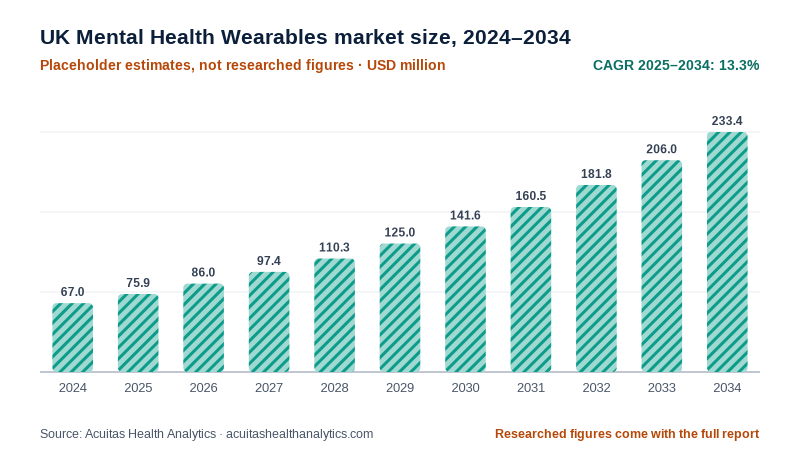
Values shown here are placeholder estimates, not researched figures. Researched 2024 historical, 2025 base-year and 2026–2034 forecast values are prepared with the full report.


 Germany at $97.0 Mn.
 Russia at 14.8% a year.
Source: Acuitas Health Analytics. Full methods, sources and usage terms come with report purchase.
$157.5 Mn total, 2026–2034
| Year | Market size | Change that year | Since 2025 |
|---|---|---|---|
| 2024 (estimate) | $67.0 Mn | — | — |
| 2025 (base) | $75.9 Mn | +$8.9 Mn | — |
| 2026 (forecast) | $86.0 Mn | +$10.1 Mn | +13.3% |
| 2027 (forecast) | $97.4 Mn | +$11.4 Mn | +28.4% |
| 2028 (forecast) | $110.3 Mn | +$13.0 Mn | +45.4% |
| 2029 (forecast) | $125.0 Mn | +$14.7 Mn | +64.8% |
| 2030 (forecast) | $141.6 Mn | +$16.6 Mn | +86.7% |
| 2031 (forecast) | $160.5 Mn | +$18.8 Mn | +111.5% |
| 2032 (forecast) | $181.8 Mn | +$21.3 Mn | +139.7% |
| 2033 (forecast) | $206.0 Mn | +$24.2 Mn | +171.5% |
| 2034 (forecast) | $233.4 Mn | +$27.4 Mn | +207.7% |
Placeholder estimates. Each year is projected from our earlier market estimate and its CAGR. Researched values come with the full report.
 US
$997.0 Mn
 Canada
$227.7 Mn
 China
$196.9 Mn
 Japan
$147.2 Mn
Germany
$97.0 Mn
UK (this report)
$75.9 Mn
 France
$75.1 Mn
 Brazil
$75.9 Mn
 Italy
$68.8 Mn
 Ecuador
$58.7 Mn
 India
$56.6 Mn
 Spain
$43.4 Mn
 Mexico
$43.1 Mn
 Saudi Arabia
$40.0 Mn
 Australia
$28.3 Mn
 New Zealand
$26.7 Mn
Russia
$24.9 Mn
 South Africa
$16.0 Mn
 UAE
$12.0 Mn
 Egypt
$8.1 Mn
 Philippines
$5.8 Mn
 Malaysia
$4.9 Mn
 Hong Kong
$4.3 Mn
 Singapore
$3.3 Mn
 Thailand
$2.8 Mn
 Kenya
$2.0 Mn
| Market size, 2025 | $75.9 Mn placeholder estimate |
|---|---|
| Forecast, 2034 | $233.4 Mn placeholder estimate |
| Growth (CAGR), 2025–2034 | 13.3% placeholder estimate |
| Years | 2024 historical · 2025 base year · 2026–2034 forecast |
| Segments | Product, use and end user (see all) |
| Key players | Oura, Apple Inc., Fitbit Inc., Muse (Interaxon), Apollo Neuroscience (see all) |
| Regulator in the UK | MHRASource: Medicines and Healthcare products Regulatory Agency. Checked 14 Nov 2026. |
| Formats | PDF, PPTX, XLSX |
Sizes and growth here are placeholder estimates, not researched figures. Researched figures come with the full report.
Mental health wearables track signals such as heart rate variability, sleep and skin response to estimate stress and support mental wellbeing.
Key segments of the mental Health Wearables market include product (Smartwatches and Bands, Rings and EEG Headbands) and use (Stress Monitoring, Sleep Tracking and Neurofeedback).
More people seeking help for mental health, less stigma, better screening and new treatments with faster effects are driving the mental Health Wearables market. Governments and employers are investing more in mental health care.
Digital tools, new drug classes and care built into primary care and workplaces give the mental Health Wearables market strong room to grow worldwide.
Shortages of mental health professionals, limited insurance coverage, side effects and the need for long-term treatment hold back the mental Health Wearables market.
The mental Health Wearables market is moderately concentrated. Leading companies compete on product innovation, clinical evidence, pricing and geographic reach, and use partnerships and acquisitions to expand their portfolios.
Medical devices sold in Great Britain need UKCA or CE marking and registration with the Medicines and Healthcare products Regulatory Agency (MHRA).[1] The NHS gives care that is free at the point of use; in England, NICE advises which medicines and treatments the NHS should fund.[2] Suicide rate: 10.1 per 100,000 people in 2023, the latest WHO figure for the UK.[3]
[1] Medicines and Healthcare products Regulatory Agency. Checked 14 Nov 2026.
[2] National Institute for Health and Care Excellence. Checked 14 Nov 2026.
[3] WHO Global Health Observatory, Suicide rate (per 100,000 people). Retrieved 28 Nov 2026.
Medical device rules, such as the US FDA 510(k) and PMA pathways and the EU Medical Device Regulation, govern how mental Health Wearables products are approved and monitored. Reimbursement codes and hospital purchasing policies decide how widely they are used in the UK.
What doctors and scientists are doing in Mental Health Wearables right now, from free public sources.
10.1 per 100,000 people
Suicide rate, UK, 2023 (WHO).
Compare every country on the Public Health DashboardSources: PubMed (US National Library of Medicine), ClinicalTrials.gov, WHO Global Health Observatory, World Bank. Fetched 28 Nov 2026. Papers and trials are found by search words, so the counts are a guide. Titles only; read each paper at its source.
[1] WHO Global Health Observatory, Suicide rate (per 100,000 people). Retrieved 27 Nov 2026.
[2] World Bank Open Data, Health spending per person (US$ per person). Retrieved 28 Nov 2026.
[3] World Bank Open Data, Doctors (per 1,000 people). Retrieved 28 Nov 2026.
From our blog
UK · 1 shared keyword
UK · 1 shared keyword
UK · 1 shared keyword
UK · 1 shared keyword
UK · 1 shared keyword
UK
OTC & Nutraceuticals · UK
Pharmaceuticals · UK
Digital Health · UK
Digital Health · UK
Digital Health · UK
Pharmaceuticals · UK