Canada Women's Health Supplements Market Industry Trends and Forecast to 2034: Segmented by (Form, Application, Region) - Growth, Market Size, Future Prospects & Competitive Analysis, 2024-2034
Overview
Market Dashboard
Canada · 2024–2034 · placeholder estimates
Values shown here are placeholder estimates, not researched figures. Researched 2024 historical, 2025 base-year and 2026–2034 forecast values are prepared with the
full report.
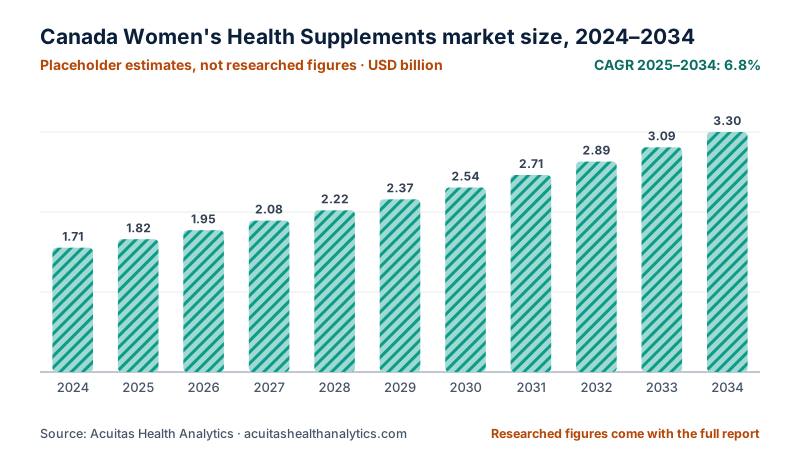
Estimate 2024$1.71 BnPlaceholder estimate
Estimate 2025$1.82 Bn8% of the global market
Projected 2034$3.30 Bn 80.8%Adds $1.47 Bn over 9 forecast years
CAGR 2025–20346.8%Faster than 41% of 82 OTC & Nutraceuticals markets here
Sizes and growth here are placeholder estimates, not researched figures. Researched figures come with the full report.
The Canada Women's Health Supplements Market Analysis Executive Summary
Women’s health supplements are dietary products specifically formulated to meet the unique nutritional needs of women at different life stages, including adolescence, pregnancy, lactation, and menopause. These supplements often contain essential vitamins and minerals such as calcium, iron, folic acid, vitamin D, and B vitamins, which are critical for supporting reproductive health, bone density, and overall well-being. They aim to address common deficiencies that may arise due to dietary restrictions or increased nutritional demands during specific life phases.
Globally, the scenario for women’s health supplements is characterized by a growing awareness of women's specific health needs and an increasing acceptance of dietary supplements as a means to achieve optimal health. Research indicates that approximately 30% of women in the United States report using dietary supplements regularly. This trend is echoed in other regions, driven by factors such as rising health consciousness and the aging population seeking preventive health measures. For instance, studies show that pregnant women often take folic acid supplements to reduce the risk of neural tube defects, while postmenopausal women are encouraged to use calcium and vitamin D to support bone health. However, despite the high adoption rates, there are ongoing concerns regarding the quality and regulation of these products, emphasizing the need for informed consumer choices and education on appropriate supplementation.
Canada Women's Health Supplements market size, 2024–2034. Placeholder estimates; researched figures come with the full report. Source: Acuitas Health Analytics.
Canada Women's Health Supplements Market Dynamics
Market Growth Drivers
The scenario for women’s health supplements is characterized by a growing recognition of the importance of tailored nutrition for women. Research indicates that women are significant consumers of dietary supplements, with studies showing that approximately 77% of women utilize at least one type of supplement to support their health. This trend is particularly evident during pregnancy and menopause, where specific nutrient requirements increase. For instance, a study highlighted the importance of calcium and vitamin D supplementation for menopausal women to combat osteoporosis. Additionally, the rise in health awareness and preventive healthcare practices has led many women to seek out these products as part of their daily health regimen
Opportunity
There is an opportunity to create supplements that cater to the specific needs of women like supplements that aid in menstruation or alleviating menopause symptoms. Additionally there is an opportunity for companies to create plant-based women's health supplements that can cater to consumers who are vegetarian, vegan or those who do not want to consume supplements with meat based ingredients.
Market Restraints
The main restraint of this market is the stiff competition as this is a popular market. This competition makes it difficult for newer and smaller brands to gain a market share. This also leads to an overproduction of similar products, and price wars. Another factor affecting this market is the increase in consumers who are moving away from dietary supplements and instead focusing on engaging in regular exercise and eating healthier diets. This might lead to products such as weight loss supplements becoming less popular among the consumer base.
Competitive Landscape for Women's Health Supplements Market in Canada
In November 2025, O Positiv launched Willo Hair Growth Support Capsules, supplements that are meant to help women with thinning hair.
In October 2025, Essentials by Revivele was launched by Revivele, a supplement meant to help with women's cognitive function, disease prevention, and hormone balance particularly in the peri and post-menopausal periods of their lives.
In August 2025, HANX launched Pregnancy and Menopause Support, two supplements aimed to help improve overall health during these two critical periods of their lives.
Mergers and Acquisitions
In April 2021, Nestle acquired the Bounty Group including Nature’s Bounty for $7.5 billion. This has allowed Nestle to expand their presence in the health supplement world.
Healthcare Policies and Regulatory Landscape for Women's Health Supplements Market in Canada
Women's Health Supplements in Canada: rules
Health Canada reviews drugs and must authorise them before they can be sold.[1] Vitamins, minerals and herbal remedies are natural health products and need a Health Canada product licence, shown by an NPN number, before sale.[2]
Women's health supplements are considered a dietary supplement in most regions, so they must meet the safety requirements, labeling standards and product certifications set out by the various regulatory bodies. Although laws around dietary supplements may be similar across continents, they are not identical and this makes launching products simultaneously in different countries difficult. Additionally all health claims made about women's health supplements must be substantiated by scientific proof in order for companies to get approval to launch their products. This has proven difficult and has resulted in companies spreading false claims about their products.
7.11 Pure Encapsulations, LLC Product & Services, Strategies & Financials
8 Healthcare Policies and Regulatory Landscape
8.1 Policy changes and Reimbursement scenario
8.2 Government Initiatives / Intervention programs
The Women's Health Supplements Market is divided into following segments: Form, Application, and Region. As these segments grow, you will be able to analyze the industries' meagre growth areas and give users useful market insights and an overview to aid in their strategic decision-making when it comes to selecting key market applications.
Sources:PubMed (US National Library of Medicine),
ClinicalTrials.gov,
World Bank.
Fetched 9 Nov 2026. Papers and trials are found by search words, so the counts are a guide. Titles only; read each paper at its source.
Public data, with sources
Women's Health Supplements in context
Canada compared
Health spending per person: 6,378 US$ per person (2024). World: 1,317 US$ per person (2023).[1]
Doctors: 2.82 per 1,000 people (2023). World: 1.86 per 1,000 people (2022).[2]
People aged 65 and over: 20.3% of people (2025). World: 10.4% of people (2025).[3]
[1]World Bank Open Data, Health spending per person (US$ per person). Retrieved 18 Nov 2026.
How big is the Women's Health Supplements market in Canada?
Placeholder estimate: about $1.82 Bn in 2025, rising to about $3.30 Bn by 2034. These are early estimates, not researched figures; the researched values come with the full report.
How fast is the Women's Health Supplements market in Canada growing?
Placeholder estimate: about 6.8% a year (CAGR, 2025–2034). The researched growth rate comes with the full report.
What segments does the Women's Health Supplements market report cover?
The report splits the market by form (Capsules, Liquids, Powders, Tablets) and application (Beauty Supplements, Hair Growth Supplements, Menopause Supplements, Pre and Post Natal Supplements and more).
Who are the key players in the Women's Health Supplements market?
Key players include Abott, AdvoCare, Amway, Banyan Botanicals, Biocyte Laboratory and Country Life, among 11 companies the report profiles.
What is driving the Women's Health Supplements market?
The scenario for women’s health supplements is characterized by a growing recognition of the importance of tailored nutrition for women.
Who regulates Women's Health Supplements in Canada?
Health Canada reviews drugs and must authorise them before they can be sold. Vitamins, minerals and herbal remedies are natural health products and need a Health Canada product licence, shown by an NPN number, before sale. Source: Health Canada. Checked 14 Nov 2026.Source: Health Canada. Checked 14 Nov 2026.
 Canada



 US
 China
 Japan
 Germany
 France
 UK
 Brazil
 Italy
 Ecuador
 Spain
 India
 Saudi Arabia
 Mexico
 Australia
 South Africa
 UAE
 Egypt
 Philippines
 Malaysia
 Hong Kong
 Singapore
 Thailand
 Kenya