 GSK PLC
Hong Kong at a glance
- Population
- 7.5 million 2025
- Life expectancy at birth
- 85.4 years, 2024
- People aged 65 and over
- 23.7 % of people, 2025
 Hong Kong
Updated
 Reviewed by Vidhi Upadhyay
Hong Kong Cardiovascular Health Supplements Market Industry Trends and Forecast to 2034: Segmented by (Ingredient, Type, Region) - Growth, Market Size, Future Prospects & Competitive Analysis, 2024-2034
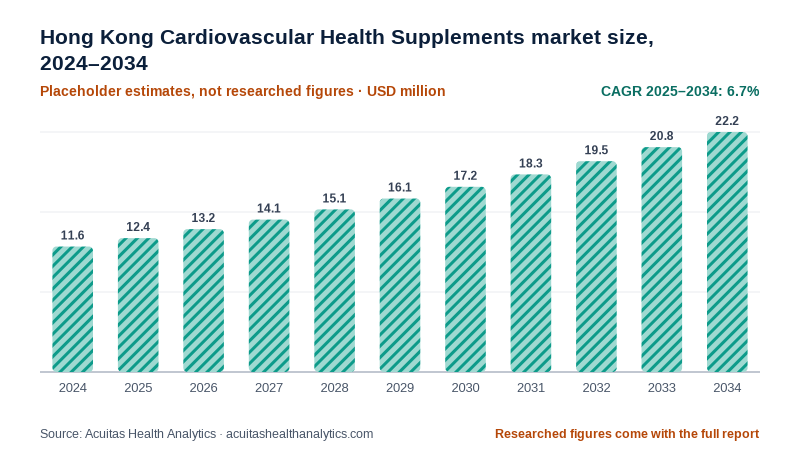
Hong Kong · 2024–2034 · placeholder estimates
Values shown here are placeholder estimates, not researched figures. Researched 2024 historical, 2025 base-year and 2026–2034 forecast values are prepared with the full report.
 China at $628.1 Mn.
 India at 8.7% a year.
Source: Acuitas Health Analytics. Full methods, sources and usage terms come with report purchase.
$9.8 Mn total, 2026–2034
| Year | Market size | Change that year | Since 2025 |
|---|---|---|---|
| 2024 (estimate) | $11.6 Mn | — | — |
| 2025 (base) | $12.4 Mn | +$0.8 Mn | — |
| 2026 (forecast) | $13.2 Mn | +$0.8 Mn | +6.7% |
| 2027 (forecast) | $14.1 Mn | +$0.9 Mn | +13.8% |
| 2028 (forecast) | $15.1 Mn | +$0.9 Mn | +21.5% |
| 2029 (forecast) | $16.1 Mn | +$1.0 Mn | +29.6% |
| 2030 (forecast) | $17.2 Mn | +$1.1 Mn | +38.3% |
| 2031 (forecast) | $18.3 Mn | +$1.1 Mn | +47.6% |
| 2032 (forecast) | $19.5 Mn | +$1.2 Mn | +57.5% |
| 2033 (forecast) | $20.8 Mn | +$1.3 Mn | +68% |
| 2034 (forecast) | $22.2 Mn | +$1.4 Mn | +79.3% |
Placeholder estimates. Each year is projected from our earlier market estimate and its CAGR. Researched values come with the full report.
 US
$3.07 Bn
China
$628.1 Mn
 Canada
$607.8 Mn
 Japan
$476.7 Mn
 Germany
$268.7 Mn
 France
$205.0 Mn
 UK
$190.1 Mn
 Brazil
$193.5 Mn
 Italy
$180.6 Mn
 Ecuador
$153.7 Mn
 Spain
$143.8 Mn
India
$146.2 Mn
 Saudi Arabia
$132.8 Mn
 Mexico
$114.5 Mn
 Australia
$93.8 Mn
 South Africa
$50.5 Mn
 UAE
$38.7 Mn
 Egypt
$21.8 Mn
 Philippines
$16.9 Mn
Hong Kong (this report)
$12.4 Mn
 Malaysia
$12.2 Mn
 Singapore
$9.3 Mn
 Thailand
$9.2 Mn
 Kenya
$5.5 Mn
| Market size, 2025 | $12.4 Mn placeholder estimate |
|---|---|
| Forecast, 2034 | $22.2 Mn placeholder estimate |
| Growth (CAGR), 2025–2034 | 6.7% placeholder estimate |
| Years | 2024 historical · 2025 base year · 2026–2034 forecast |
| Segments | Ingredient and type (see all) |
| Key players | Amway, GNC Holdings Inc, InVite Health, Herbalife International of America, Inc, Nature’s Way Products, Inc and 6 more (see all) |
| Regulator in Hong Kong | Drug Office and Centre for Food SafetySource: Drug Office, Department of Health. Checked 14 Nov 2026.Source: Centre for Food Safety. Checked 14 Nov 2026. |
| Formats | PDF, PPTX, XLSX |
Sizes and growth here are placeholder estimates, not researched figures. Researched figures come with the full report.
Cardiovascular health supplements are dietary products formulated to support heart health and reduce the risk of cardiovascular diseases (CVD). Common ingredients include omega-3 fatty acids, coenzyme Q10 (CoQ10), plant sterols, garlic, and various vitamins and minerals. These supplements aim to improve heart function, lower cholesterol levels, and enhance overall cardiovascular health. With CVD being a leading cause of death globally, these supplements are increasingly sought after by individuals looking to adopt preventive health measures.
The global scenario for cardiovascular health supplements is characterized by a rising awareness of heart health, particularly among aging populations. Research indicates that approximately 17.9 million people die from CVD each year, making it crucial for individuals to take proactive steps in managing their heart health. Studies show that nearly 50% of adults in the U.S. use dietary supplements, with a significant portion targeting cardiovascular benefits. The increasing prevalence of lifestyle-related risk factors, such as obesity and sedentary behaviour, further drives the adoption of these supplements. However, while many consumers are turning to these products for added support, there remains debate about their efficacy, emphasizing the need for informed choices and consultation with healthcare professionals regarding their use alongside traditional medical treatments
The adoption of cardiovascular health supplements globally is positively influenced by a growing awareness of heart health and the importance of preventive care. Research indicates that cardiovascular diseases (CVD) remain a leading cause of mortality worldwide, prompting individuals to seek proactive measures to support their heart health. Studies have shown that dietary factors, such as increased intake of omega-3 fatty acids, can significantly reduce the risk of heart disease. Additionally, public health initiatives and educational campaigns have highlighted the role of nutrition in cardiovascular health, encouraging consumers to incorporate supplements like Coenzyme Q10 and plant sterols into their diets. The increasing prevalence of lifestyle-related risk factors, such as obesity and hypertension, has further driven the demand for these supplements, as individuals look for effective ways to mitigate their risks.
There is an opportunity to create products that specifically target the geriatric population as they have the highest risk of acquiring cardiovascular diseases. With the rise of consumers opting for a plant based diet there is an opportunity to create products that are completely plant-based in order to cater to this emerging market base.
One major concern is the inconsistency in scientific evidence supporting the efficacy of many products on the market. While some studies demonstrate benefits from specific ingredients, others yield mixed results, leading to consumer scepticism about their effectiveness. Additionally, safety concerns regarding potential side effects and interactions with prescription medications can deter individuals from using these supplements. The high cost associated with quality cardiovascular supplements may also limit access for certain populations, particularly those with lower incomes.
 InVite Health
 Nature’s Way Products, Inc
 Nestle
 Nordic Naturals
 Sanofi S.A
September 2025, Nutrartis launched Cardiosmile, a supplement created with plant sterols aimed to help with cholesterol management and daily heart health.
March 2025, Life Extension launched new omega-3 fish oil based gummies that have doses of DHA and EPA fatty acids.
Pharmaceutical products must be registered with the Pharmacy and Poisons Board before sale, through the Drug Office of the Department of Health.[1] Health supplements are generally regulated as food, overseen by the Centre for Food Safety; proprietary Chinese medicines must be registered with the Chinese Medicine Council.[2]
[1] Drug Office, Department of Health. Checked 14 Nov 2026.
[2] Centre for Food Safety. Checked 14 Nov 2026.
Cardiovascular Health Supplements are considered a dietary supplement in most regions, so they must meet the safety requirements, labelling standards and product certifications set out by the various regulatory bodies. Although laws around dietary supplements may be similar across continents, they are not identical and this makes launching products simultaneously in different countries difficult. Additionally all health claims made about cardiovascular health supplements must be substantiated by scientific proof in order for companies to get approval to launch their products. As businesses within this market are actively adjusting to accommodate consumer preferences they must adhere to the new regulations set in place in the post-pandemic era.
What doctors and scientists are doing in Cardiovascular Health Supplements right now, from free public sources.
Sources: PubMed (US National Library of Medicine), ClinicalTrials.gov, World Bank. Fetched 9 Nov 2026. Papers and trials are found by search words, so the counts are a guide. Titles only; read each paper at its source.
[1] World Bank Open Data, People aged 65 and over (% of people). Retrieved 27 Nov 2026.
From our blog
Hong Kong · 6 shared keywords
Hong Kong · 5 shared keywords
Hong Kong · 5 shared keywords
Hong Kong · 4 shared keywords
Hong Kong · 4 shared keywords
Hong Kong · 3 shared keywords
Digital Health · Hong Kong
Pharmaceuticals · Hong Kong
Medical Devices · Hong Kong
Medical Devices · Hong Kong
Pharmaceuticals · Hong Kong
Pharmaceuticals · Hong Kong