Hong Kong at a glance
- Population
- 7.5 million 2025
- Life expectancy at birth
- 85.4 years, 2024
- People aged 65 and over
- 23.7 % of people, 2025
 Hong Kong
Updated
 Reviewed by Chandani Patel
Hong Kong Hair Growth Supplements Market Industry Trends and Forecast to 2034: Segmented by (Product Type, Functionality, Form, Region) - Growth, Market Size, Future Prospects & Competitive Analysis, 2024-2034
Hong Kong · 2024–2034 · placeholder estimates
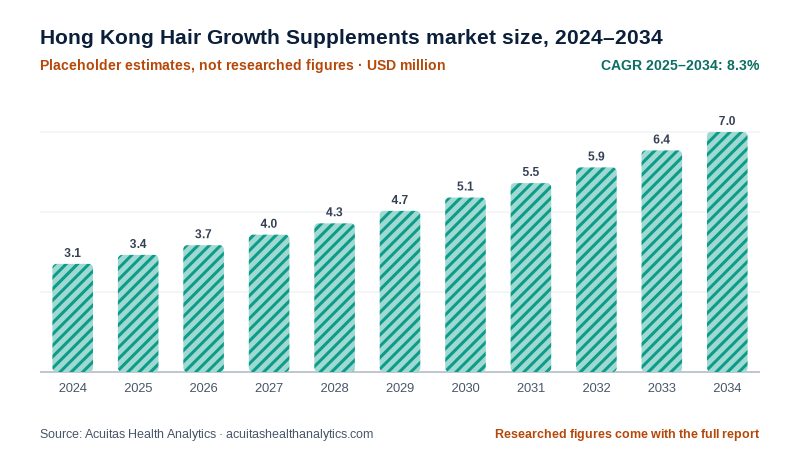
Values shown here are placeholder estimates, not researched figures. Researched 2024 historical, 2025 base-year and 2026–2034 forecast values are prepared with the full report.
 China at $171.3 Mn.
 India at 10.3% a year.
Source: Acuitas Health Analytics. Full methods, sources and usage terms come with report purchase.
$3.6 Mn total, 2026–2034
| Year | Market size | Change that year | Since 2025 |
|---|---|---|---|
| 2024 (estimate) | $3.1 Mn | — | — |
| 2025 (base) | $3.4 Mn | +$0.3 Mn | — |
| 2026 (forecast) | $3.7 Mn | +$0.3 Mn | +8.3% |
| 2027 (forecast) | $4.0 Mn | +$0.3 Mn | +17.3% |
| 2028 (forecast) | $4.3 Mn | +$0.3 Mn | +27% |
| 2029 (forecast) | $4.7 Mn | +$0.4 Mn | +37.6% |
| 2030 (forecast) | $5.1 Mn | +$0.4 Mn | +49% |
| 2031 (forecast) | $5.5 Mn | +$0.4 Mn | +61.4% |
| 2032 (forecast) | $5.9 Mn | +$0.5 Mn | +74.7% |
| 2033 (forecast) | $6.4 Mn | +$0.5 Mn | +89.2% |
| 2034 (forecast) | $7.0 Mn | +$0.5 Mn | +105% |
Placeholder estimates. Each year is projected from our earlier market estimate and its CAGR. Researched values come with the full report.
 US
$838.3 Mn
China
$171.3 Mn
 Canada
$165.8 Mn
 Japan
$130.0 Mn
 Germany
$73.3 Mn
 France
$55.9 Mn
 UK
$51.9 Mn
 Brazil
$52.8 Mn
 Italy
$49.3 Mn
 Ecuador
$41.9 Mn
 Spain
$39.2 Mn
India
$39.8 Mn
 Saudi Arabia
$36.2 Mn
 Mexico
$31.2 Mn
 Australia
$25.6 Mn
 South Africa
$13.8 Mn
 UAE
$10.6 Mn
 Egypt
$5.9 Mn
 Philippines
$4.6 Mn
Hong Kong (this report)
$3.4 Mn
 Malaysia
$3.4 Mn
 Singapore
$2.6 Mn
 Thailand
$2.5 Mn
 Kenya
$1.5 Mn
| Market size, 2025 | $3.4 Mn placeholder estimate |
|---|---|
| Forecast, 2034 | $7.0 Mn placeholder estimate |
| Growth (CAGR), 2025–2034 | 8.3% placeholder estimate |
| Years | 2024 historical · 2025 base year · 2026–2034 forecast |
| Segments | Product type, functionality and form (see all) |
| Key players | Amway, Cipla Inc., Curallux,LLC, Eli Lilly and Company, ExoCoBio, Inc and 5 more (see all) |
| Regulator in Hong Kong | Drug Office and Centre for Food SafetySource: Drug Office, Department of Health. Checked 14 Nov 2026.Source: Centre for Food Safety. Checked 14 Nov 2026. |
| Formats | PDF, PPTX, XLSX |
Sizes and growth here are placeholder estimates, not researched figures. Researched figures come with the full report.
Hair growth supplements are dietary products formulated to promote hair health and stimulate growth. These supplements typically contain a blend of vitamins, minerals, amino acids, and botanical extracts that are believed to support hair follicles and improve overall hair quality. Common ingredients include biotin, vitamin D, zinc, collagen, and various herbal extracts like saw palmetto and ginseng. The goal of these supplements is to address nutritional deficiencies that may contribute to hair thinning or loss, particularly in conditions such as androgenetic alopecia.
Globally, the scenario for hair growth supplements is characterized by increasing consumer interest and usage. Research indicates that hair loss affects a significant portion of the population, with approximately 50 million men and 30 million women in the United States experiencing some form of hair loss. This has led to a surge in demand for supplements that claim to enhance hair growth and health. A study found that many individuals turn to these products as part of their daily regimen, often influenced by social media and celebrity endorsements. However, while many consumers report positive outcomes, there remains a need for more rigorous scientific evidence to substantiate the claims made by manufacturers regarding the efficacy of these supplements.
The global demand for hair growth supplements continues to be bolstered by the growing public concern over hair health, and the prevailing conditions of hair loss. Studies show that at least one half of all men and a third of all women in America experience some degree of hair thinning, which causes many people to seek for a solution. This has in turn elicited much concern and as such, people are using various supplements such as biotin, collagen and various herbal extracts that are believed to enhance hair growth. Also, the use of social media and beauty influencers has highly increased the awareness of these products and forced consumers to look for better products to improve their hair health. The tendency towards comprehensive health and disease prevention also contributes to the use of hair growth supplements in that people seek to enhance their appearance through dietary intervention.
There is an opportunity to diversify product portfolios by adding newer hair growth supplement types like vitamin gummies. This will attract new customers and give them a wide variety of choice when selecting hair growth supplements.
Several challenges hinder the widespread adoption of hair growth supplements. One major issue is the inconsistency in scientific evidence regarding the effectiveness of many products available in the market. While some studies suggest that certain ingredients can promote hair health, others show mixed results, leading to consumer scepticism about their efficacy. Additionally, safety concerns about potential side effects or interactions with other medications may deter individuals from using these supplements. The relatively high cost of quality hair growth supplements can also limit access for some consumers, particularly those with lower incomes. Furthermore, regulatory inconsistencies regarding labelling and marketing claims can create confusion among consumers about which products are genuinely effective, ultimately impacting their willingness to adopt these supplements as part of their hair care regimen
 Eli Lilly, and Company
 Keranique
 Nature’s Bounty
 Nutraceutical Wellness, Inc
In June 2025, the U.S Food and Drug Administration approved Pfizer Inc’s LITFULO, a once daily oral treatment for consumers 12 years and older.
In April 2025, Divi launched All-New Hair Vitamins in order to boost hair care routine and promote a healthy scalp.
In January 2025, Nutrafol announced the launch of hair supplements to the beauty supplier Sephora.
In June 2022, the U.S Food and Drug Administration approved OLUMINANT, a once daily pill as a treatment for adults with severe alopecia areata a type of hair loss disorder.
Pharmaceutical products must be registered with the Pharmacy and Poisons Board before sale, through the Drug Office of the Department of Health.[1] Health supplements are generally regulated as food, overseen by the Centre for Food Safety; proprietary Chinese medicines must be registered with the Chinese Medicine Council.[2]
[1] Drug Office, Department of Health. Checked 14 Nov 2026.
[2] Centre for Food Safety. Checked 14 Nov 2026.
Hair Growth Supplements are considered dietary supplements in most regions, so they must meet the safety requirements, labelling standards and product certifications set out by the various regulatory bodies. Unless specifically approved companies who manufacture hair growth supplements cannot claim to treat or cure any diseases according to the U.S FDA. Although laws around dietary supplements may be similar across continents, they are not identical and this makes launching products simultaneously in different countries difficult. Additionally all health claims made about hair growth supplements must be substantiated by scientific proof in order for companies to get approval to launch their products.
What doctors and scientists are doing in Hair Growth Supplements right now, from free public sources.
Sources: PubMed (US National Library of Medicine), ClinicalTrials.gov, World Bank. Fetched 9 Nov 2026. Papers and trials are found by search words, so the counts are a guide. Titles only; read each paper at its source.
[1] World Bank Open Data, People aged 65 and over (% of people). Retrieved 23 Nov 2026.
From our blog
Hong Kong · 3 shared keywords
Hong Kong · 2 shared keywords
Hong Kong · 2 shared keywords
Hong Kong · 2 shared keywords
Hong Kong · 2 shared keywords
Hong Kong · 2 shared keywords
Pharmaceuticals · Hong Kong
Medical Devices · Hong Kong
Medical Devices · Hong Kong
Digital Health · Hong Kong
Healthcare Services · Hong Kong
Pharmaceuticals · Hong Kong