Hong Kong at a glance
- Population
- 7.5 million 2025
- Life expectancy at birth
- 85.4 years, 2024
- People aged 65 and over
- 23.7 % of people, 2025
 Hong Kong
Updated
 Reviewed by Chandani Patel
Hong Kong Plant-Based Supplements Market Industry Trends and Forecast to 2034: Segmented by (Raw Material, Product Type, Application, Region) - Growth, Market Size, Future Prospects & Competitive Analysis, 2024-2034
Hong Kong · 2024–2034 · placeholder estimates
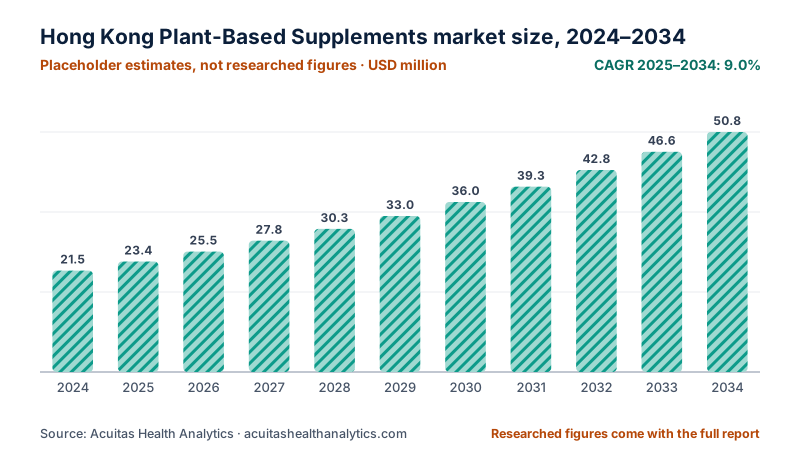
Values shown here are placeholder estimates, not researched figures. Researched 2024 historical, 2025 base-year and 2026–2034 forecast values are prepared with the full report.
 China at $1.19 Bn.
 India at 11% a year.
Source: Acuitas Health Analytics. Full methods, sources and usage terms come with report purchase.
$27.4 Mn total, 2026–2034
| Year | Market size | Change that year | Since 2025 |
|---|---|---|---|
| 2024 (estimate) | $21.5 Mn | — | — |
| 2025 (base) | $23.4 Mn | +$1.9 Mn | — |
| 2026 (forecast) | $25.5 Mn | +$2.1 Mn | +9% |
| 2027 (forecast) | $27.8 Mn | +$2.3 Mn | +18.8% |
| 2028 (forecast) | $30.3 Mn | +$2.5 Mn | +29.5% |
| 2029 (forecast) | $33.0 Mn | +$2.7 Mn | +41.2% |
| 2030 (forecast) | $36.0 Mn | +$3.0 Mn | +53.9% |
| 2031 (forecast) | $39.3 Mn | +$3.2 Mn | +67.7% |
| 2032 (forecast) | $42.8 Mn | +$3.5 Mn | +82.8% |
| 2033 (forecast) | $46.6 Mn | +$3.9 Mn | +99.3% |
| 2034 (forecast) | $50.8 Mn | +$4.2 Mn | +117.2% |
Placeholder estimates. Each year is projected from our earlier market estimate and its CAGR. Researched values come with the full report.
 US
$5.80 Bn
China
$1.19 Bn
 Canada
$1.15 Bn
 Japan
$900.1 Mn
 Germany
$507.8 Mn
 France
$387.2 Mn
 UK
$359.3 Mn
 Brazil
$365.3 Mn
 Italy
$341.1 Mn
 Ecuador
$290.3 Mn
 Spain
$271.8 Mn
India
$275.6 Mn
 Saudi Arabia
$250.7 Mn
 Mexico
$216.2 Mn
 Australia
$177.0 Mn
 South Africa
$95.4 Mn
 UAE
$73.1 Mn
 Egypt
$41.2 Mn
 Philippines
$31.9 Mn
 Malaysia
$23.2 Mn
Hong Kong (this report)
$23.4 Mn
 Singapore
$17.5 Mn
 Thailand
$17.4 Mn
 Kenya
$10.2 Mn
| Market size, 2025 | $23.4 Mn placeholder estimate |
|---|---|
| Forecast, 2034 | $50.8 Mn placeholder estimate |
| Growth (CAGR), 2025–2034 | 9.0% placeholder estimate |
| Years | 2024 historical · 2025 base year · 2026–2034 forecast |
| Segments | Raw material, product type and application (see all) |
| Key players | Abbott Laboratories, AMCO proteins, Glanbia PLC, IOVATE Health Sciences International, Inc, MusclePharm Corporation and 5 more (see all) |
| Regulator in Hong Kong | Drug Office and Centre for Food SafetySource: Drug Office, Department of Health. Checked 14 Nov 2026.Source: Centre for Food Safety. Checked 14 Nov 2026. |
| Formats | PDF, PPTX, XLSX |
Sizes and growth here are placeholder estimates, not researched figures. Researched figures come with the full report.
Plant-based supplements are products derived from plants, including herbs, fruits, vegetables, and other botanical sources, designed to enhance health and well-being. These supplements can take various forms, such as capsules, powders, teas, or extracts, and are often used to provide essential nutrients, support immune function, or promote overall health. Common examples include turmeric (curcumin), echinacea, and spirulina. The popularity of plant-based supplements has surged as consumers increasingly seek natural alternatives to synthetic medications and prioritize holistic health approaches.
Globally, the adoption of plant-based supplements is on the rise due to a growing trend towards health consciousness and preventive care. According to a survey conducted by the National Institutes of Health, approximately 18% of adults in the U.S. reported using herbal or botanical supplements. This trend is echoed in other regions as well, with consumers increasingly turning to plant-based options for their perceived health benefits. Research indicates that plant-based diets and supplements can reduce the risk of chronic diseases and improve overall health outcomes. Additionally, the rise of social media and wellness influencers has played a significant role in promoting these products. However, challenges such as regulatory inconsistencies and varying product quality still exist, impacting consumer trust and access to these beneficial supplements.
The adoption of plant-based supplements globally is positively influenced by a rising awareness of health benefits and a growing preference for natural products. Research has shown that plant-based supplements can provide essential nutrients, antioxidants, and phytochemicals that support overall health and may reduce the risk of chronic diseases such as heart disease, obesity, and diabetes. For instance, studies indicate that certain plant-based supplements, like omega-3 fatty acids from algae and curcumin from turmeric, have anti-inflammatory properties that can benefit health. Additionally, the increasing concern for environmental sustainability and animal welfare has led many consumers to seek plant-based alternatives, as these products are often perceived as more eco-friendly. The popularity of veganism and vegetarianism, particularly among younger demographics, further drives the demand for innovative plant-based supplements that cater to diverse dietary preferences
There is opportunity to create plant based alternatives to popular supplements like iron and protein supplements. Companies can also create products that help vegan consumers reach their nutritional goals by providing additional supplementation.
Several challenges can hinder the widespread adoption of plant-based supplements. One major issue is the prevalence of misinformation regarding their efficacy and nutritional completeness compared to traditional supplements. Research indicates that some consumers may be skeptical about whether plant-based supplements can provide adequate amounts of essential nutrients, such as protein and vitamins B12 and D. Additionally, the variability in product quality poses a significant concern; not all plant-based supplements are created equal, leading to inconsistencies in potency and effectiveness. Regulatory oversight is often lacking, which can result in misleading labeling and consumer distrust. Furthermore, higher costs associated with quality plant-based products can limit access for lower-income populations, creating disparities in who can benefit from these health-promoting options
 AMCO proteins
 Glanbia PLC
 IOVATE Health Sciences International, Inc
 Quest Nutrition
 WOODBOLT DISTRIBUTION LLC
In August 2022, Vital Nutrients launched a plant based omega supplement created from algae.
In February 2022, SlimPlus was launched by ZeNutra, which a vegan weight loss powder created for weight management and waist slimming.
In August 2021, Nutraceuticals and Fulllife collaborated to create a new plant-based nutraceutical product containing Vitamin B12 and B complex.
In 2021, Nestle acquired Organic LLC, a maker of plant based nutritional and organic food supplements.
Pharmaceutical products must be registered with the Pharmacy and Poisons Board before sale, through the Drug Office of the Department of Health.[1] Health supplements are generally regulated as food, overseen by the Centre for Food Safety; proprietary Chinese medicines must be registered with the Chinese Medicine Council.[2]
[1] Drug Office, Department of Health. Checked 14 Nov 2026.
[2] Centre for Food Safety. Checked 14 Nov 2026.
Plant-Based Supplements are considered a dietary supplement in most regions, so it must meet the safety requirements, labelling standards and product certifications set out by the various regulatory bodies. Although laws around dietary supplements may be similar across continents, they are not identical and this makes launching products simultaneously in different countries difficult. The regulations of plant-based supplements in the USA are different from what the European Food and Safety Authority requires. Additionally all health claims made about plant-based supplements must be substantiated by scientific proof in order for companies to get approval to launch their products.
What doctors and scientists are doing in Plant-Based Supplements right now, from free public sources.
Sources: PubMed (US National Library of Medicine), ClinicalTrials.gov, World Bank. Fetched 9 Nov 2026. Papers and trials are found by search words, so the counts are a guide. Titles only; read each paper at its source.
[1] World Bank Open Data, People aged 65 and over (% of people). Retrieved 15 Nov 2026.
From our blog
Hong Kong · 6 shared keywords
Hong Kong · 5 shared keywords
Hong Kong · 4 shared keywords
Hong Kong · 4 shared keywords
Hong Kong · 4 shared keywords
Hong Kong · 4 shared keywords
Pharmaceuticals · Hong Kong
Pharmaceuticals · Hong Kong
Pharmaceuticals · Hong Kong
Medical Devices · Hong Kong
Public Health · Global
Public Health · Global