Hong Kong Cancer Supportive Care Drugs Market Analysis Industry Trends and Forecast to 2034: Segmented by (By Drug Class, By Cancer Type, By Distribution Channel, By Geography) - Growth, Market Size, Future Prospects & Competitive Analysis, 2024-2034
Overview
Market Dashboard
Hong Kong · 2024–2034 · placeholder estimates
Values shown here are placeholder estimates, not researched figures. Researched 2024 historical, 2025 base-year and 2026–2034 forecast values are prepared with the
full report.
Estimate 2024$42.0 MnPlaceholder estimate
Estimate 2025$44.4 Mn0.2% of the global market
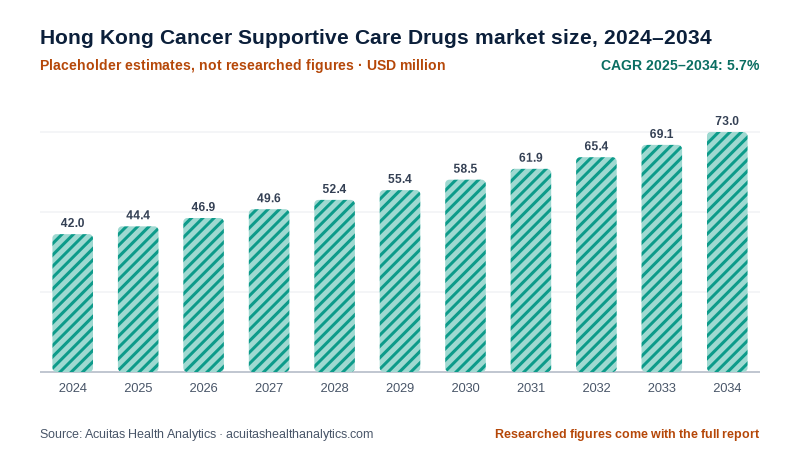
Projected 2034$73.0 Mn 64.7%Adds $28.7 Mn over 9 forecast years
CAGR 2025–20345.7%Faster than 12% of 194 Pharmaceuticals markets here
61 in Hong KongSource: ClinicalTrials.gov, Studies recruiting, active or not yet recruiting, in Hong Kong. Retrieved 9 Nov 2026.
Formats
PDF, PPTX, XLSX
Sizes and growth here are placeholder estimates, not researched figures. Researched figures come with the full report.
The Hong Kong Cancer Supportive Care Drugs Market Analysis Executive Summary
Patients with cancer face a variety of problems because of their disease, including physical, psychological, and occupational problems. Also, many suffer from adverse effects of cancer treatment which may be early, delayed or enduring. Such problems are not only personal but can also have implications for the patient’s management plan. In case of complications, it may lead to early termination, modifications, dose changes or reductions of anti-cancer treatments causing higher risks for the patient.
According to WHO, cancer is the cause of nearly 10 million deaths in 2020, or 16% of all deaths. Supportive drugs, also known as protective drugs, are not used to treat cancer itself, they play a crucial role in enhancing the overall treatment experience. The cancer supportive care market focuses on alleviating symptoms caused by cancer treatments, such as pain, nausea, anemia, and infections, ultimately improving patient comfort and quality of life. With increased global cancer rates, there is an increasing need for supportive care. These are the toxicity associated with more aggressive therapies, the higher risk among elderly, and changes in patient expectations of the quality of the remaining years of life. However, there are barriers like high costs, side effects of supportive drugs and regulatory issues. The market trends include the use of biomarkers for personalized care, oral medication preference, telemedicine, and the incorporation of hospice care. It is anticipated that the market will continue to expand, with more emphasis placed on advancements, patient-centred strategies, and increasing access and affordability in the global setting.
Hong Kong Cancer Supportive Care Drugs market size, 2024–2034. Placeholder estimates; researched figures come with the full report. Source: Acuitas Health Analytics.
Hong Kong Cancer Supportive Care Drugs Market Dynamics
Market Growth Drivers
The market for supportive care medications is stimulated by the increasing global cancer rate, projected to be at 28.4 million new cases in the next 20 years. With success rates of cancer treatments like chemotherapy and immunotherapy improving over the years, the need for supportive care drugs for symptoms such as pain, nausea, and fatigue also rises. Further, a higher tendency of cancer and chronic diseases among aged people is fueling demand for such drugs. Healthcare associations and regulatory bodies are now placing increased focus on supportive care to enhance the quality of life of patients and have included it as a part of the standard palliative treatment. New treatment solutions for supportive care are being developed which are more effective and safer, such as the use of biologics and targeted delivery systems.
Opportunity
New applications for supportive care medications could complement cancer therapy regimen. Targeted therapies that act specifically on the genetic profile of a given patient and their cancer might be less toxic and more effective. Other forms of medication administration like patch and long-acting injections could increase compliance and ease. Biologics and biosimilars with less side effects compared to conventional chemotherapies, and the incorporation of integrated digital health solutions can potentially enhance patient outcomes. With the improvement of healthcare systems in emergent markets supportive care will emerge as one of the key needs fueled by the patient-centred approach.
Market Restraints
New cancer supportive care products are likely to face difficulty entering the market due to high research and development cost especially for new entrant firms. Concern that the growth of generics and biosimilars will reduce the market share and pricing of branded products. Lack of awareness among patients and healthcare givers might lead to low utilization of supportive care solutions. Also, an increasing adoption of targeted therapies and immunotherapies, many of which are less toxic to the body, could lead to decreased demand for some of the supportive care drugs. Lifestyle diseases and poor health care facilities in the developing world may also hinder usage of these commodities hence limiting market size.
Competitive Landscape for Cancer Supportive Care Drugs Market in Hong Kong
August 2020, FDA Approves First Liquid Biopsy Next-Generation Sequencing Companion Diagnostic Test.
May 2025, RedHill Biopharma Ltd. announced that it holds patents for RHB-102 (BEKINDA) in both the European Union and the United States. RHB-102 is developed to treat nausea and vomiting caused by chemotherapy and radiotherapy.
January 2025, Helsinn Healthcare SA and Immedica Pharma AB announced an exclusive long-term agreement to commercialize two cancer supportive care products, Akynzeo and Aloxi, in key European markets. These products are designed to prevent chemotherapy-induced nausea and vomiting (CINV).
October 2025, Merck & Co. invested $5.5 billion in a partnership with Daiichi Sankyo to develop three new antibody-drug conjugates. These cancer therapies, which could eventually be valued at up to $22 billion, provide an alternative to chemotherapy and may reduce damage to healthy cells.
Mergers and Acquisitions
Q4 2025, Pfizer has recently completed a $43 billion acquisition of cancer specialist Seagen. Seagen is a world-leading biotech company and a market leader in antibody drug conjugate technology. Pfizer is restructuring around Seagen, so this means that they respect the trajectory that they are already taking.
Healthcare Policies and Regulatory Landscape for Cancer Supportive Care Drugs Market in Hong Kong
Cancer Supportive Care Drugs in Hong Kong: rules, payment and research
Pharmaceutical products must be registered with the Pharmacy and Poisons Board before sale, through the Drug Office of the Department of Health.[1] Public hospitals and clinics, run by the Hospital Authority, are heavily subsidised by the government.[2] ClinicalTrials.gov lists 61 studies on Cancer Supportive Care Drugs that are recruiting, active or about to start in Hong Kong.[3]
[3]ClinicalTrials.gov, Studies recruiting, active or not yet recruiting, in Hong Kong. Retrieved 9 Nov 2026.
Policy changes and Reimbursement scenario
New forms of reimbursement are shifting from fee-for-service in cancer treatment, and emphasize patient-centred care and cost-effective interventions like supportive care that enhance the patient’s overall well-being and decrease hospital readmissions. However, what constitute value in cancer care is not well understood and payers are increasingly questioning the cost of cancer drugs and demanding rebates from pharmaceutical firms. Some payers have adopted step treatment regulations that compel patients to use cheaper supportive care medications first. New supportive care services are added to Medicare, but Australians still face high out-of-pocket costs and gaps.
Patient-reported outcomes (PROs) are rising in relevance, with payers demanding data on supportive care effectiveness. Nonetheless, there is still restricted compensation for psychosocial support services, as many payers impose severe limitations on coverage, which negatively impacts patients with a small number of financial opportunities.
Source: ClinicalTrials.gov, Active studies (recruiting, about to start or running) each company leads, found with this market's trial search, worldwide. Retrieved 13 Nov 2026.
Source: Drugs@FDA, US approvals each company holds for medicines on the market whose FDA label lists this use. Retrieved 13 Nov 2026.
Beyond the market numbers
Research, trials and patients
What doctors and scientists are doing in Cancer Supportive Care Drugs right now, from free public sources.
Sources:PubMed (US National Library of Medicine),
ClinicalTrials.gov,
World Bank.
Fetched 9 Nov 2026. Papers and trials are found by search words, so the counts are a guide. Titles only; read each paper at its source.
Public data, with sources
Cancer Supportive Care Drugs in context
Hong Kong compared
People aged 65 and over: 23.7% of people (2025). World: 10.4% of people (2025). 2nd highest of the 18 countries we cover in APAC.[1]
[1]World Bank Open Data, People aged 65 and over (% of people). Retrieved 28 Nov 2026.
How big is the Cancer Supportive Care Drugs market in Hong Kong?
Placeholder estimate: about $44.4 Mn in 2025, rising to about $73.0 Mn by 2034. These are early estimates, not researched figures; the researched values come with the full report.
How fast is the Cancer Supportive Care Drugs market in Hong Kong growing?
Placeholder estimate: about 5.7% a year (CAGR, 2025–2034). The researched growth rate comes with the full report.
What segments does the Cancer Supportive Care Drugs market report cover?
The report splits the market by drug class (Granulocyte Colony-Stimulating Factors (G-CSFs), Erythropoiesis-Stimulating Agents (ESAs), Antiemetics, Bisphosphonates and more), cancer type (Breast Cancer, Lung Cancer, Prostate Cancer, Colorectal Cancer and more) and distribution channel (Hospital Pharmacies, Retail Pharmacies, Online Pharmacies, Compounding Pharmacies).
What is driving the Cancer Supportive Care Drugs market?
The market for supportive care medications is stimulated by the increasing global cancer rate, projected to be at 28.4 million new cases in the next 20 years.
Who regulates Cancer Supportive Care Drugs in Hong Kong?
Pharmaceutical products must be registered with the Pharmacy and Poisons Board before sale, through the Drug Office of the Department of Health. Source: Drug Office, Department of Health. Checked 14 Nov 2026.
How is healthcare paid for in Hong Kong?
Public hospitals and clinics, run by the Hospital Authority, are heavily subsidised by the government. Source: Hospital Authority. Checked 14 Nov 2026.
How many clinical trials on Cancer Supportive Care Drugs are running in Hong Kong?
61 studies are recruiting, active or about to start in Hong Kong, according to ClinicalTrials.gov. Source: ClinicalTrials.gov, Studies recruiting, active or not yet recruiting, in Hong Kong. Retrieved 9 Nov 2026.
How much research is published on Cancer Supportive Care Drugs?
PubMed lists 9,991 papers on Cancer Supportive Care Drugs added since January 2021, worldwide. Source: PubMed, Papers added since 1 January 2021 matching this market. Retrieved 9 Nov 2026.
 Hong Kong

 China
 India
 US
 Canada
 Japan
 Germany
 France
 UK
 Brazil
 Italy
 Ecuador
 Spain
 Saudi Arabia
 Mexico
 Australia
 South Africa
 UAE
 Egypt
 Philippines
 Malaysia
 Singapore
 Thailand
 Kenya
 Novartis AG
 Johnson & Johnson
 Amgen
 Merck & Co., Inc.
 Hoffmann-La Roche
 GlaxoSmithKline Plc
 Pfizer Inc.
 Fresenius SE & CO
 Viatris
 AstraZeneca
 Hikma Pharmaceuticals PLC
 AbbVie Inc.