Hong Kong Functional Food Market Industry Trends and Forecast to 2034: Segmented by (Ingredient, Application, Form) - Growth, Market Size, Future Prospects & Competitive Analysis, 2024-2034
Overview
Market Dashboard
Hong Kong · 2024–2034 · placeholder estimates
Values shown here are placeholder estimates, not researched figures. Researched 2024 historical, 2025 base-year and 2026–2034 forecast values are prepared with the
full report.
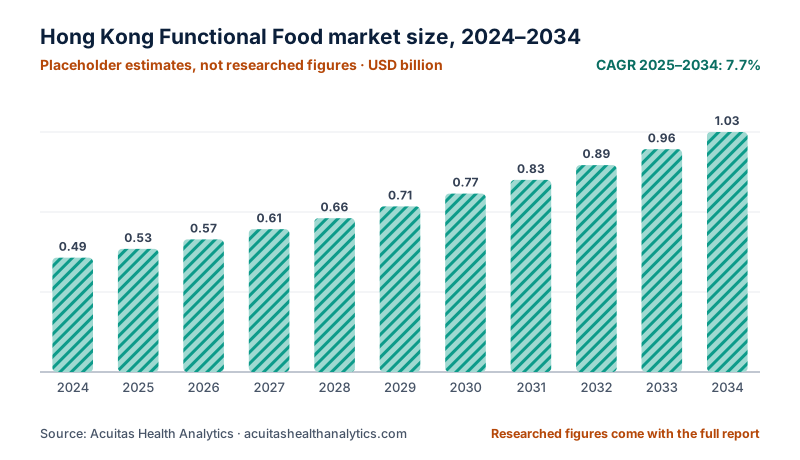
Estimate 2024$491.9 MnPlaceholder estimate
Estimate 2025$529.7 Mn0.2% of the global market
Projected 2034$1.03 Bn 95%Adds $503.0 Mn over 9 forecast years
CAGR 2025–20347.7%Faster than 40% of 82 OTC & Nutraceuticals markets here
24 in Hong KongSource: ClinicalTrials.gov, Studies recruiting, active or not yet recruiting, in Hong Kong. Retrieved 9 Nov 2026.
Formats
PDF, PPTX, XLSX
Sizes and growth here are placeholder estimates, not researched figures. Researched figures come with the full report.
The Hong Kong Functional Food Market Analysis Executive Summary
Functional foods are defined as foods that provide health benefits beyond basic nutrition, often containing bioactive compounds that can help prevent disease and promote overall health. These foods can be whole, fortified, enriched, or enhanced, and include items like fruits, vegetables, whole grains, and products fortified with vitamins, minerals, probiotics, or omega-3 fatty acids. The concept of functional foods originated in Japan in the 1980s and has since gained global recognition due to their potential role in preventing chronic diseases such as heart disease, diabetes, and cancer.
According to the Institute of Health Metrics and Evaluation 10.61% of all deaths in 2021 were associated with poor diets while 30% of cardiovascular deaths were linked to poor diets. There is an increased demand for functional foods as more consumers become more aware of the benefits of these products and shift towards preventive health. The scenario for functional foods reflects a growing trend towards health-conscious eating. Research indicates that the functional food market is expanding as consumers increasingly seek out foods that offer additional health benefits. A study published in Nutrients noted that the consumption of functional foods is associated with a reduced risk of chronic diseases and improved quality of life. For example, the introduction of iron-fortified foods has significantly decreased iron deficiency anemia rates in various populations. As awareness of the health benefits of functional foods continues to rise, more individuals are incorporating these products into their diets. This shift is evident in dietary patterns worldwide, with many consumers prioritizing nutrient-dense options to enhance their overall health and well-being.
Hong Kong Functional Food market size, 2024–2034. Placeholder estimates; researched figures come with the full report. Source: Acuitas Health Analytics.
Hong Kong Functional Food Market Dynamics
Market Growth Drivers
The adoption of functional foods is positively influenced by increasing consumer awareness of health and wellness, particularly in the context of chronic disease prevention. Research indicates that as people become more health-conscious, they actively seek out foods that offer additional health benefits beyond basic nutrition. For instance, a study published in Nutrients found that individuals with higher levels of nutrition knowledge are more likely to consume functional foods, as they understand the potential health benefits associated with bioactive compounds. Additionally, the global market for functional foods has been growing at an annual average rate of approximately 8.5%, reflecting a rising demand for products that can improve health outcomes. The increasing prevalence of lifestyle-related diseases, such as obesity and diabetes, has further driven interest in functional foods that can help mitigate these conditions. Furthermore, the convenience and accessibility of these products in supermarkets and online platforms have made them more appealing to consumers, leading to greater adoption across various demographics.
Opportunity
Consumer awareness and education about preventive health has increased, also increasing the demand for functional foods thereby creating opportunity for companies to launch novel products to gain a larger market share. There have been many strides in the technology used to create functional foods like encapsulation technology which encourages key players to broaden their product catalog. The projected growth of the geriatric population to 1.6 billion in 2050 is also an opportunity for companies in this market to create products that cater to this specific customer base.
Market Restraints
One significant barrier is consumer skepticism regarding the efficacy and safety of these products. Research has shown that many consumers are hesitant to try new functional foods due to concerns about unfamiliar ingredients or potential side effects, a phenomenon known as "food neophobia." Additionally, taste remains a critical factor; studies indicate that consumers often prioritize flavour over health benefits, leading to reluctance in adopting products perceived as unpalatable. Price sensitivity also plays a role; while some consumers are willing to pay a premium for health benefits, others may find functional foods too expensive compared to conventional options
Competitive Landscape for Functional Food Market in Hong Kong
February 2024, ENOUGH and Cargill deepened their strategic relationship by boosting the production of ENOUGH’s meat alternative meat product ABUNDA.
October 2022, Teijin Japan Limited was launched by Teijin Limited in order to develop and produce probiotics aimed toward making functional foods.
Mergers and Acquisitions
In June 2025, Brightseed and ADM formed a partnership aimed to develop scientific-based functional food products that will enhance the functions of the human body's microbiome.
Healthcare Policies and Regulatory Landscape for Functional Food Market in Hong Kong
Functional Food in Hong Kong: rules and research
Pharmaceutical products must be registered with the Pharmacy and Poisons Board before sale, through the Drug Office of the Department of Health.[1] Health supplements are generally regulated as food, overseen by the Centre for Food Safety; proprietary Chinese medicines must be registered with the Chinese Medicine Council.[2] ClinicalTrials.gov lists 24 studies on Functional Food that are recruiting, active or about to start in Hong Kong.[3]
[3]ClinicalTrials.gov, Studies recruiting, active or not yet recruiting, in Hong Kong. Retrieved 9 Nov 2026.
All health claims that are made about functional foods must be substantiated by scientific proof in order for companies to get approval to launch their products. Regulatory laws that are not uniform across regions makes it difficult for companies to launch new products simultaneously in different regions. Additionally there has been a lot of mistrust from consumers surrounding the effectiveness of functional foods and the quality of raw products used to make them hence prompting governing bodies to impose new laws that regulate the type of ingredients used in these products. For example The European Union has set up the Novel Foods Regulation in order to assess the raw ingredients used in the production of functional foods.
8.2 Government Initiatives / Intervention programs
The Functional Food Market is divided into following segments:Source, Application and Type. As these segments grow, you will be able to analyze the industries' meagre growth areas and give users useful market insights and an overview to aid in their strategic decision-making when it comes to selecting key market applications.
Other companies that free public records show in this market: trials they lead, US approvals and WHO prequalification. They are not part of our key players research. Each count opens its source.
Also active in this area, from free public records
Source: ClinicalTrials.gov, Active studies (recruiting, about to start or running) each company leads, found with this market's trial search, worldwide. Retrieved 13 Nov 2026.
Beyond the market numbers
Research, trials and patients
What doctors and scientists are doing in Functional Food right now, from free public sources.
Sources:PubMed (US National Library of Medicine),
ClinicalTrials.gov,
World Bank.
Fetched 9 Nov 2026. Papers and trials are found by search words, so the counts are a guide. Titles only; read each paper at its source.
Public data, with sources
Functional Food in context
Hong Kong compared
People aged 65 and over: 23.7% of people (2025). World: 10.4% of people (2025). 2nd highest of the 16 countries we cover in APAC.[1]
[1]World Bank Open Data, People aged 65 and over (% of people). Retrieved 16 Nov 2026.
How big is the Functional Food market in Hong Kong?
Placeholder estimate: about $529.7 Mn in 2025, rising to about $1.03 Bn by 2034. These are early estimates, not researched figures; the researched values come with the full report.
How fast is the Functional Food market in Hong Kong growing?
Placeholder estimate: about 7.7% a year (CAGR, 2025–2034). The researched growth rate comes with the full report.
What segments does the Functional Food market report cover?
The report splits the market by ingredient (Hybrid sources, Natural ingredients, Synthetic ingredients), application (Beverages, Food, Nutraceuticals and Dietary Supplements) and form (Capsules and Tablets, Liquids, Powders, Others).
Who are the key players in the Functional Food market?
Key players include A&B Ingredients, Inc, Ajinomoto Co, Arla Foods, ADM, BASF SE and Chr Hansen A/S, among 17 companies the report profiles.
What is driving the Functional Food market?
The adoption of functional foods is positively influenced by increasing consumer awareness of health and wellness, particularly in the context of chronic disease prevention.
Who regulates Functional Food in Hong Kong?
Pharmaceutical products must be registered with the Pharmacy and Poisons Board before sale, through the Drug Office of the Department of Health. Health supplements are generally regulated as food, overseen by the Centre for Food Safety; proprietary Chinese medicines must be registered with the Chinese Medicine Council. Source: Drug Office, Department of Health. Checked 14 Nov 2026.Source: Centre for Food Safety. Checked 14 Nov 2026.
How many clinical trials on Functional Food are running in Hong Kong?
24 studies are recruiting, active or about to start in Hong Kong, according to ClinicalTrials.gov. Source: ClinicalTrials.gov, Studies recruiting, active or not yet recruiting, in Hong Kong. Retrieved 9 Nov 2026.
How much research is published on Functional Food?
PubMed lists 24,362 papers on Functional Food added since January 2021, worldwide. Source: PubMed, Papers added since 1 January 2021 matching this market. Retrieved 9 Nov 2026.
 Hong Kong



 China
 India
 US
 Canada
 Japan
 Germany
 France
 UK
 Brazil
 Italy
 Ecuador
 Spain
 Saudi Arabia
 Mexico
 Australia
 South Africa
 UAE
 Egypt
 Philippines
 Malaysia
 Singapore
 Thailand
 Kenya
 General Mills
 International Flavors & Fragrances Inc
 Ingredion
 Nestle
 PepsiCo
 Roche
 Pfizer Inc.
 Novartis AG
 Novo Nordisk A/S
 ViiV Healthcare